Whistler Multi-Activity Zipline Day Packages: What's Actually Included
What is a Whistler multi-activity zipline day package?
It is a catalogue product that bundles a guided zipline tour with one or more add-on activities — such as a wildlife-focused walk, ATV riding, or a meal — sold and run as a single day, usually with round-trip transport from Whistler Village included. It is not a fixed-site adventure park with multiple attractions under one roof; it is a scheduled combination of separate activities stitched into one itinerary.
What a “multi-activity” zipline package actually bundles
Search for a Whistler zipline and the results split into two shapes of product that look similar but are not. One is a standalone zipline tour: you ride a set of lines, you’re done in two to three hours, and that’s the whole booking. The other is a catalogue package that bundles the zipline with something else on the same ticket — a guided wildlife walk, an off-road ride, a multi-course lunch — sold and scheduled as one combined day. This guide is about the second kind, and about the one mix-up that costs people a wasted afternoon: mistaking a multi-activity package for a fixed-site adventure park.
A multi-activity package is not a place you walk into. It’s an itinerary. A guide meets your group, usually with pickup from Whistler Village, and moves you through the components in a set order and a set amount of time. Compare that with a true adventure park, where you buy one admission and then move freely between stations — a ropes course here, an axe-throwing bay there, a zipline run somewhere else — for as long as the site is open. Squamish has that kind of fixed-site park, covered separately in the Squamish Canyon adventure park guide; it is a different product from what’s described here, even though both involve a zipline.
The practical difference matters because it changes what you’re actually paying for. A multi-activity package charges for guiding, transport between components, and the coordination of fitting two or three separate activities into one day. A fixed-site park charges for access to infrastructure you use at your own pace. Neither is better — they suit different kinds of days — but booking the wrong one leaves you either stuck on a rigid schedule when you wanted to wander, or wandering a single site when you wanted a guided day that covers more ground.
The activities that commonly get paired with a zipline
Not every add-on shows up in every package, but a handful of combinations recur across Whistler’s catalogue:
| Add-on paired with ziplining | What it typically adds | Best suited to |
|---|---|---|
| Guided wildlife or wilderness walk | 30–60 minutes on forest trails with a naturalist guide, often bear-aware | Anyone curious about the valley’s ecology without a serious hike |
| Off-road / side-by-side riding | 1–2 hours driving or riding forest service roads | Visitors who want speed and terrain, not just canopy views |
| Multi-course guided lunch | A seated meal, usually mid-package, at 3–4 stops around the village | Groups treating the day as a full outing rather than a quick activity |
| Evening or night-walk add-on | A multimedia forest walk after dark, on a separate booking slot | Visitors staying an extra evening and wanting something calmer |
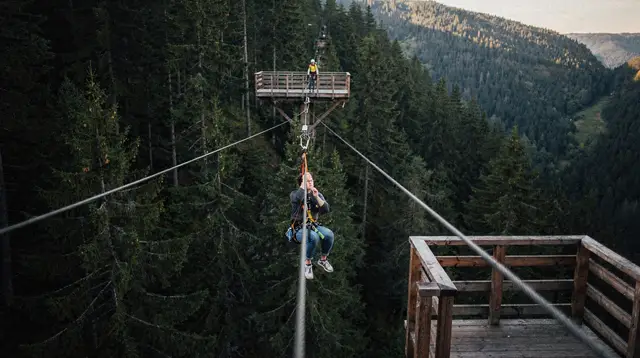
A representative example is the Superfly Ziplines Adventure with day activities, which folds a zipline circuit together with additional activities into one scheduled outing rather than leaving you to book each piece separately. Another common shape pairs the ride with a guided nature component, such as the Ziptrek zipline experience combined with a bear-focused guided tour — useful context for black bear season timing if wildlife is your main interest, though a sighting is never guaranteed on any tour.
If ziplining itself, rather than the pairing, is the deciding factor, it’s worth knowing Whistler is also home to one of the continent’s longest single lines: the Whistler zipline billed as the longest in North America. That’s a standalone product, covered in full in the longest zipline in North America guide — worth reading before you decide whether you want the line itself or the fuller day a package provides.
When a multi-activity package makes sense — and when it doesn’t
A package earns its extra cost when a day trip is genuinely tight. If you’re doing a one-day visit to Whistler Village or a Vancouver day trip and want to leave having done more than one thing, bundling saves the separate transport, separate check-ins and separate scheduling that two standalone bookings would need. It also suits groups with mixed interests — one person wants the adrenaline, another wants the wildlife walk — where a single combined booking avoids splitting the group for half the day.
It makes less sense if you actually want to linger. Packages run to a schedule, and that schedule is built around moving the whole group through each component in turn. If your priority is a slow, unhurried afternoon at your own pace, a fixed-site option — the Squamish Canyon adventure park, or simply the Whistler Village Stroll on foot — suits that better than a package built for throughput.
It’s also the wrong fit if the extra activity doesn’t interest you. Paying for a bundled lunch or off-road segment you’d rather skip rarely saves money over booking the standalone zipline on its own and spending the saved time elsewhere — at Lost Lake, on the Train Wreck Trail, or trying Vallea Lumina as a separate evening outing.
A side-by-side comparison of the common combinations lives in the multi-activity day packages compared guide, which is worth checking before committing to one bundle over another.
Why June to August is the strongest window for these packages
Whistler’s zipline lines themselves can run for much of the year, but the multi-activity packages built around outdoor add-ons are strongest in summer, specifically June to August. Forest trails used for the guided walk components are reliably clear of snow by then, daylight runs long enough to fit two or three activities into a single afternoon without racing the sunset, and the off-road routes used for side-by-side add-ons are at their most accessible. Outside that window, packages either shrink to fewer components or swap an outdoor add-on for something indoor.
That seasonal shape lines up with the rest of Whistler’s summer program — the bike park, the lake swimming season, and the alpine hiking trails around Garibaldi and Joffre Lakes all open on a similar calendar. If your trip falls outside June–August, check the specific package listing for what the shoulder-season version includes rather than assuming the full summer combination is on offer; a best-time-to-visit guide covers how the wider activity calendar shifts month to month.
A word on where these packages start
Nearly every version of this product begins with pickup or check-in in Whistler Village — the resort’s pedestrian core, built between 1978 and 1980 on what had been a municipal landfill, chosen deliberately as a flat, central site the whole valley could be organized around.
That history is worth knowing mainly because it explains why the village has no old town to wander before or after your activity — it was purpose-built as an access point, not preserved from an earlier settlement. The background is covered in more detail in why Whistler Village has no old town, and it’s a useful thing to set expectations around if you’re budgeting spare time before a morning pickup.
Because pickup is centralized, these packages work well for visitors without a car — one of several reasons a car-free week in Whistler is a realistic plan, not just a slogan. Confirm the exact meeting point on your voucher, since a handful of operators use a secondary pickup spot in the Upper Village rather than the main Village Stroll.
Add-ons beyond hiking and wildlife
Not every package leans outdoors. Two other pairings show up regularly in Whistler’s catalogue and are worth knowing about even if they’re not the headline product:
A food-focused version threads a guided, multi-course lunch between activity stops rather than leaving you to find your own meal mid-day. The guided four-course progressive lunch tour is the clearest example — it moves between several village restaurants over a scheduled sitting rather than seating you at one table for the whole meal, which makes it easy to combine with an earlier zipline slot. A close cousin worth comparing is the self-guided culinary pass lunch option, which drops the guide and the fixed schedule in exchange for more flexibility.
For a faster-paced pairing, some packages swap the wildlife walk for off-road driving. The side-by-side off-road adventure covers forest service roads by vehicle rather than on foot, and suits visitors who want a second adrenaline activity rather than a calmer nature stop after the zipline.
Checking the fine print before you book
Because “multi-activity” covers a wide range of actual combinations, the listing details matter more than the headline name. Before booking, confirm:
- What’s actually included. Two packages both called “zipline plus adventure” can mean a nature walk in one case and an off-road ride in the other — read the itinerary line by line, not just the title.
- Total duration, including transport. A package advertised as “half day” can still run close to five hours once pickup, briefing and drop-off are counted.
- Minimum age and weight limits, which typically apply separately to the zipline component and to any off-road or climbing add-on, and can differ between them.
- What happens in poor weather. Zipline operations pause in high wind or lightning; ask whether the add-on activity runs regardless or is affected by the same conditions — a relevant question for a rainy-day activities guide if your trip dates are weather-uncertain.
- Group versus private format. Multi-activity days are more often run in fixed groups than standalone zipline tours are, since the schedule has to keep several activities moving together.
Whistler multi-activity zipline package FAQ
How is a multi-activity zipline package different from booking a zipline tour alone?
A standalone zipline tour is one activity: the ride itself, typically two to three hours including safety briefing and transport. A multi-activity package adds at least one more component — a guided walk, an off-road ride, a meal — to the same day, usually for a longer combined outing and a single combined price.
Is a multi-activity zipline package the same as an adventure park?
No. An adventure park is a fixed site you enter once and move between several self-guided or lightly guided stations, such as ropes courses, axe throwing and a canopy walk, at your own pace within opening hours. A multi-activity zipline package is a guided, scheduled combination of separate activities, often at more than one location, run to a fixed itinerary rather than a free-roam visit.
What time of year do these packages run?
The zipline itself typically operates year-round in Whistler, but the combined outdoor packages that pair it with hiking, wildlife walks or off-road add-ons are strongest from June to August, when trails are clear of snow and daylight is longest. Some winter versions swap the outdoor add-on for an indoor or shorter component.
How long does a full multi-activity day take?
Plan on four to six hours door to door once transport, safety briefing, the zipline circuit and the added activity are all included. A few packages that add a full meal or a longer off-road segment run closer to a full day.
Do I need experience for the added activities?
No prior experience is expected for the common add-ons — guided walks, wildlife-viewing stops, off-road riding as a passenger or beginner driver — since these packages are built for general visitors, not specialists. Anyone with a specific mobility or fitness concern should check the minimum age and weight limits before booking.
Can I do the zipline and skip the extra activity?
Yes, by booking a standalone zipline tour instead of a multi-activity package. The packages exist specifically for visitors who want to compress more of Whistler into one booked day rather than arranging each activity separately.
Where do these packages start and finish?
Almost all of them start with pickup or check-in in Whistler Village, since it is the resort’s pedestrian hub built in the late 1970s specifically as a central meeting point, and most return to the same spot at the end of the day.
Ziplining on GetYourGuide
Verified deep-linked GetYourGuide tours. Book through these links and we earn a small commission at no cost to you.
GetYourGuide does not provide a product photo for this activity — the image shows the meeting point, photographed by us.