How the Whistler Culinary Pass Works for a Self-Guided Lunch
What is the Whistler culinary pass and is it guided?
It is a self-guided lunch discovery pass, not an accompanied tour: you receive a voucher or map for several village eateries and walk between them on your own schedule. Whistler Village is pedestrian and only about 15 minutes end to end, so there is no vehicle and no fixed group pace involved.
Eating your way through Whistler Village on your own schedule
A self-guided culinary pass solves a very specific problem: you want to sample more than one Whistler restaurant at lunch, but you do not want a guide setting the pace, a fixed meeting time, or a group of strangers deciding how long the appetizer course takes. The format sold as a self-guided lunch discovery does exactly that. You are handed a route, a voucher, or a booking confirmed for a handful of participating stops, and from that point on the schedule is entirely yours. This is the single detail that separates it from the accompanied dinner version of the same idea, and it is worth being precise about before you book, because the two are easy to confuse.
a self-guided lunch discovery pass through Whistler Village is the reference booking for this exact format, and everything below describes how that kind of pass actually works on the ground, in Whistler Village itself.
What “self-guided” actually means here
Self-guided is not a marketing softener. It means there is no host walking the group between restaurants, no shared start time everyone has to hit, and no pace dictated by the slowest or fastest eater in a group. In practice, once you have your pass or voucher confirmed:
- You choose when to start, generally within the restaurants’ lunch service window.
- You choose the order in which you visit each stop.
- You decide how long to spend at each one — lingering over coffee costs you nothing but time.
- You can pause, browse the Village Stroll, and resume whenever you like.
This is the opposite arrangement to a guided progressive meal, where a host leads a fixed group from restaurant to restaurant on a set timetable. If what you actually want is company, commentary, and a host handling reservations and pacing for you, that is a different product, covered on its own page and not what this pass is.
Why Whistler Village makes this format work at all
Self-guided food passes only work well in places small enough to navigate without help, and Whistler Village happens to be close to ideal. It is entirely pedestrian: through-traffic is kept to the perimeter, cars are left in day lots or hotel parking, and the whole network of stone-paved lanes, the Village Stroll and the Upper Village is built for walking. Locals and repeat visitors describe it in one useful number: end to end, on foot, at an ordinary pace, Whistler Village takes about 15 minutes to cross.
That number matters for a culinary pass because it means travel time between stops is close to irrelevant. Even if your route includes venues at opposite ends of the village, you are looking at a few minutes of walking between them, not a drive or a shuttle. There is no risk of a self-guided pass falling apart because you misjudge distances — the geography does the work for you. It is also why the village has no need for a car once you are there: the WAVE local bus covers the rest of the valley, but inside the village itself, walking is simply faster than any alternative.
One consequence worth flagging for first-time visitors: Whistler Village was built from 1978 to 1980 on a former municipal landfill, which is why it has no historic old town in the European sense. What it does have is a compact, deliberately walkable pedestrian core designed around exactly this kind of grazing, stop-to-stop dining. The lack of history is a fair trade for a layout this convenient for a self-guided lunch.
What a typical self-guided lunch pass includes
Formats vary by season and by which restaurants are currently participating, so treat the specifics as indicative rather than fixed, and always check the current inclusions at booking. In general terms, a self-guided lunch discovery pass structures a single meal — an appetizer-style course, a main, and something sweet, for example — across two or three separate restaurants rather than one sitting in one place. The idea is less “cheaper lunch” and more “taste more of the village in one visit” without needing to book, arrive, and pay at each restaurant separately.
Because it is self-guided, what you are actually purchasing is the coordination: pre-arranged access at each stop, a defined route or list of participating restaurants, and a single transaction instead of three. What you are not purchasing is a host, a fixed start time for the whole group, or commentary between courses — that is the paid difference with the guided version.
Where a lunch pass fits into a Whistler day
Because the self-guided format only takes two to three hours and never requires a car, it slots easily around almost anything else on a Whistler itinerary rather than anchoring the whole day. A few common pairings:
- A half-day hike, then lunch. An outing like the guided hike to Cheakamus Lake in Garibaldi Provincial Park finishes back near the valley in time for an afternoon lunch pass, without the logistics of a second reservation somewhere far from the village.
- A morning on the mountain, lunch back in the village. Skiers and bike park riders alike tend to want an easy, no-planning meal once they are back at valley level, which is exactly what a self-guided pass is built for.
- A Vancouver day trip. Visitors doing a day trip from Vancouver with a guided village tour often have only a few free hours in Whistler itself; a self-guided lunch pass fits inside that window because it needs no advance meeting point beyond the village.
- A rest day. On a multi-day stay, a self-guided lunch pass is a low-effort way to fill a slower day without arranging transport anywhere.
If your day trip plan is tighter than a few hours, check how much time a Whistler day trip from Vancouver actually needs before assuming a lunch pass and a village tour both fit comfortably.
Prices, tax and tipping — the part that surprises visitors
Every price you see advertised for a tour, activity, or restaurant package in Whistler is shown before tax. British Columbia adds 5% GST, plus an 8% provincial sales tax, and accommodation carries an additional 3% Municipal and Regional District Tax on top of that. None of this is included in the sticker price for a culinary pass, so the number at checkout will be somewhat higher than the number advertised.
Tipping is the second cost that catches first-time visitors off guard. In Canadian restaurants generally, and in Whistler specifically, a tip of 15% to 20% of the pre-tax bill is the norm, not an optional extra. On a multi-stop lunch pass, that expectation can apply at each individual restaurant rather than once for the whole package, so it is worth asking when you book whether gratuity is handled centrally or left to you at each stop.
| Cost element | Included in the advertised price? |
|---|---|
| The meal courses at each participating stop | Yes |
| 5% GST | No — added at checkout or at the till |
| 8% PST | No — added at checkout or at the till |
| Tip (15-20%) | No — expected separately, per restaurant unless stated otherwise |
Whistler is expensive by Canadian standards generally — a single lift ticket bought at the window in peak season can run well over CAD 200 — and dining follows the same pattern. Budgeting for tax and tip on top of a lunch pass, rather than being surprised by them, keeps the format the good value it is meant to be. For a broader sense of what a Whistler trip costs day to day, see how much a Whistler ski trip typically costs and practical budget tips for Whistler.
How this differs from the guided dinner tour
It is worth stating the distinction one more time plainly, because the two products sit close together in most booking platforms and use similar language. The self-guided lunch pass described on this page has no guide, no fixed group, and no set start time beyond the restaurants’ own service hours — you are simply given access and a route, and you manage the rest.
A separate, guided evening product exists that runs across four courses with a host accompanying a group between restaurants on a fixed schedule; that format has its own dedicated coverage and is not what is being described here. If you are drawn to the idea of commentary, introductions at each stop, and not having to think about logistics at all, that guided version — not this self-guided lunch pass — is the one to look at.
Practical tips for a self-guided lunch pass
A few things make the self-guided format run more smoothly:
- Book ahead in peak season. Winter weekends and the height of summer bring the valley’s population up several times over its roughly 14,000 permanent residents, and participating restaurants can fill their lunch slots.
- Confirm the current route before you arrive. Which restaurants participate can change season to season; a quick check the morning of your pass avoids walking to a stop that has rotated out.
- Wear real shoes, not just resort sandals. The Village Stroll and surrounding lanes are paved and easy, but Whistler’s weather changes quickly even in summer.
- Leave the car where it is. There is no advantage to driving between stops inside the village — parking a second time costs more than the few minutes saved, and paid winter day-lot parking makes it actively worse.
- Pace yourself on portions. Multi-stop formats work best if you treat each course as a taste rather than a full plate, leaving room for what comes next.
Culinary pass, self-guided lunch discovery
Is the Whistler culinary pass a guided tour?
No. It is explicitly self-guided: you get vouchers or a route for a set of stops and decide yourself when to arrive, how long to linger, and in what order to eat. There is no guide walking with you and no group to keep up with.
How long does the self-guided lunch pass take?
Most visitors spend around two to three hours moving between stops, but because it is self-paced you can stretch it over an afternoon or finish quickly. The village itself is walkable end to end in about 15 minutes, so travel time between stops is never the limiting factor.
Do I need a car to do the culinary pass?
No. Whistler Village is a pedestrian zone: cars are parked at its edges and every stop on a village-based lunch pass is reachable on foot. This is one of the few Whistler activities where car-free visitors have no disadvantage at all.
Are taxes and tip included in the price?
No. Prices shown for tours and dining in Whistler are before tax. Expect 5% GST plus 8% PST and, on accommodation only, a 3% MRDT. In restaurants, a tip of 15-20% is expected on top of the bill, so budget for it separately from the pass price.
What is the difference between this pass and the 4-course dinner tour?
The dinner tour is a guided, accompanied evening experience with a set group and a host leading you between restaurants. The culinary pass covered here is a self-guided lunch format: no guide, no fixed group, and you choose your own timing within the village.
Is the culinary pass available year-round?
Whistler Village restaurants operate year-round, so a self-guided lunch pass is generally usable in any season. Availability of specific participating restaurants can shift between winter’s peak season and the quieter shoulder months, so check current inclusions when you book.
Can I combine the culinary pass with a hike or another activity the same day?
Yes, and it pairs naturally with a half-day activity since it takes only two to three hours. A guided hike, a village tour, or an afternoon on the lakes all leave room for a self-guided lunch before or after.
Food & Drink Tours on GetYourGuide
Verified deep-linked GetYourGuide tours. Book through these links and we earn a small commission at no cost to you.
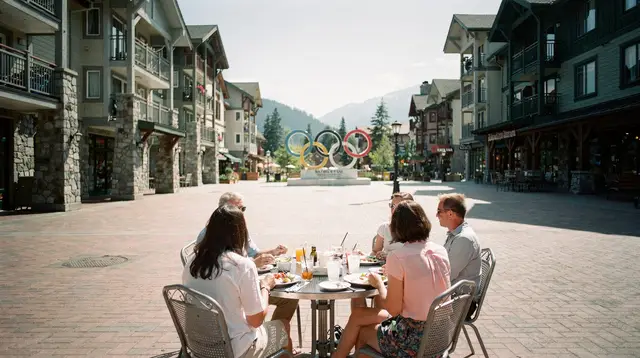
GetYourGuide does not provide a product photo for this activity — the image shows the meeting point, photographed by us.