Zipline and Bear Tour Combo in Whistler
Is a Whistler zipline and bear tour combo worth it?
Yes for most visitors with one free day: a combined tour bundles ziplining through the forest canopy with a guided drive to spot black bears, saving a transfer, a check-in and several hours versus booking both separately. Bears are seen from May to October, so the combo only makes sense in that window; outside it, book the zipline alone.
Two activities, one afternoon: does the combo actually work
Whistler sells ziplining and bear viewing as two separate products almost everywhere you look, and for good reason: one is an adrenaline circuit through the forest canopy, the other is a slow, patient scan of forestry roads and clearings for wildlife. Put them on the same booking, though, and something useful happens. You keep the adrenaline, you keep the wildlife, and you cut out the dead time between two half-day activities — a second pickup, a second briefing, a second drive up the valley.
This page is about that specific product: the combined zipline and bear tour sold as one ticket, not the standalone vehicle-based bear-viewing drive covered elsewhere on this site. If a slow scenic drive purely focused on bears is what you want, read the dedicated guide to Whistler bear-viewing tours instead. This page is for travellers who want both experiences and are deciding whether stacking them into one afternoon makes sense — or whether it is better to book each on its own day.
What a combo tour actually includes
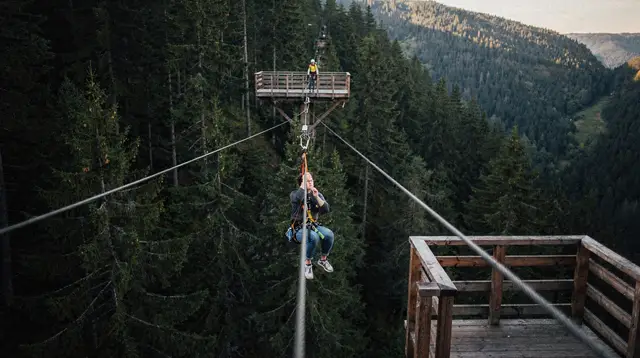
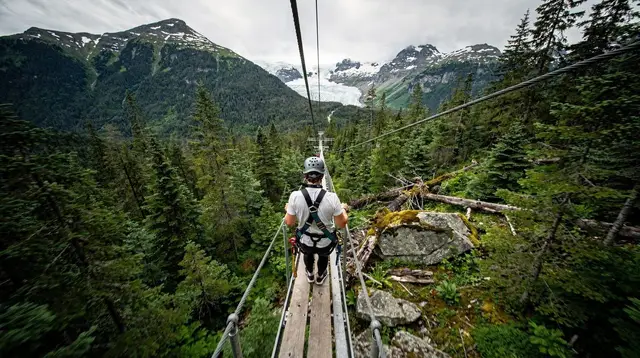
A typical zipline and bear tour combo runs in two clearly separated halves, usually with the same guide throughout. The first half is a canopy zipline circuit: a series of cables strung between platforms built into old-growth trees or across forested ravines above Whistler Village, with a safety briefing, harness and helmet fitting, and a short practice line before the real circuit begins. Circuits vary by operator — some run five or six lines, others stretch to a dozen — but all are built for first-time riders rather than experienced climbers.
The second half switches gears entirely. The group loads back into a van or open-sided vehicle and drives out along forestry roads and old logging routes around the Whistler valley, the kind of terrain bears use to move between feeding areas without crossing Highway 99 or the village itself. The guide, who typically drives this same route daily through the season, slows or stops wherever there is a fresh sign — scat, claw marks on a tree, a bear actually visible in a clearing — and narrates what the group is seeing. This half is unhurried by design: it is a scan, not a chase.
Some combo products fold in a third element, most often a stop tied to the Callaghan Valley or Whistler Olympic Park, giving the drive a second purpose beyond wildlife spotting. Read the specific tour description carefully, since “combo” is used loosely across operators and the exact mix of zipline, bear-viewing route and any extra stop differs from one product to the next.
The bears you’ll actually see
Whistler holds an established population of black bears commonly estimated at around 50 animals living in and around the resort valley — feeding on the ski runs in spring, moving through the forest along the Sea to Sky corridor, occasionally wandering into the village itself in search of unsecured food. This is the population these tours are built around, and it is worth being precise about it: every bear a combo tour is realistically going to show you is a black bear.
Grizzly bears are not part of this picture. They are extremely rare in the Sea to Sky corridor, and no honest operator should promise one, imply one is likely, or advertise a “grizzly tour” out of Whistler. If a listing anywhere suggests grizzlies as a normal sighting on a Whistler day tour, treat that as a red flag rather than a bonus. Cougars share the same forest but are almost never seen and are not part of what these tours are selling.
Sightings run roughly from May to October, tracking the black bear’s active season around Whistler: spring growth draws them to open, grassy slopes including the lower ski runs; summer keeps them foraging through the same forestry-road corridors these tours drive; and by early autumn bears are feeding hard, covering more ground and building fat reserves ahead of hibernation, which tends to make September sightings some of the most reliable of the year. Outside May to October, bears are denning and a combo tour’s wildlife half has effectively nothing to show — which is the single biggest reason to check the season before booking rather than after.
Why the combo beats booking separately — and when it doesn’t
The case for the combo is mostly about compression, not price. Book a zipline circuit and a bear-viewing drive as two separate activities and you are almost certainly looking at two pickups, two safety briefings, two blocks of a guide’s attention, and — on a short trip — two different days carved out of a limited itinerary. Fold them into one product and a single guide, a single vehicle and a single afternoon carry both halves, typically finishing in three to five hours door to door.
That compression matters most on short trips. Someone spending two or three days in Whistler around a ski trip, a hike, or a stay built around the Whistler Mountain Bike Park has limited slots for a half- or full-day activity, and a combo frees up an entire extra afternoon compared with doing both separately. It matters less on a longer stay, where there is no real cost to spacing the two activities across different days and giving each its own unhurried block of time.
The case against the combo is mostly about focus. A standalone bear-viewing drive built around exclusive access to Whistler Olympic Park or timed for the best light of the day can afford to move slower and cover more ground than the bear-viewing half of a combo, which is bookended by a zipline circuit on one side and a fixed return time on the other.
If wildlife photography is the actual priority — patient framing, waiting out a distant bear, following a route rather than a schedule — a dedicated bear tour, not a combo, is the better fit. The same logic runs the other way for zipline enthusiasts chasing the longest run or the fastest circuit: a combo’s zipline half is usually a solid, well-run introduction rather than the most technical or longest line available in the valley.
Comparing the combo to booking each activity alone
| Combined tour | Booked separately | |
|---|---|---|
| Typical duration | 3–5 hours, one afternoon | Two half-days, often two different days |
| Pickups and briefings | One of each | One of each, per activity |
| Zipline circuit | Standard beginner-friendly circuit | Choice of standard, longest, or most technical circuit |
| Bear-viewing pace | Fixed window within the combo schedule | Can run longer, slower, or timed for best light |
| Best for | Short trips, families, first-time visitors | Longer stays, wildlife photographers, zipline enthusiasts chasing a specific circuit |
| Season dependency | Only makes sense May–October | Zipline runs year-round; bear tour only May–October |
Booking a combo, a zipline, or a bear tour on its own
If a combined tour fits the trip, the Zipline Experience Ziptrek Bear Tour is built around exactly this pairing: a guided canopy circuit followed by a dedicated bear-viewing drive with the same guide, in one afternoon booking.
For travellers who would rather keep the two activities separate, or who are visiting outside bear season, the zipline half can be booked on its own through Whistler’s longest zipline in North America — a longer, faster circuit than most combo products carry, and one worth reading about in more depth on the longest zipline in North America guide.
Travellers wanting to stack ziplining with several other adventure activities in a single day, rather than pairing it specifically with bears, can look at the Superfly Ziplines Adventure with day activities, which is closer to a multi-activity package than a wildlife-focused one — see the comparison of multi-activity day packages for how it stacks up against other options.
For a standalone, unhurried bear-viewing drive with no zipline attached, the Afternoon-Evening Bear Viewing Scenic Tour runs during the part of the day when bears are often most active, and pairs well with the guide to the best time to see black bears in Whistler. Travellers who also want to see the 2010 Olympic venues alongside the wildlife drive should look at the bear tour with exclusive Olympic Park access instead, detailed on the Olympic Park bear tour guide.
Practical notes for booking and the day itself
Book combo tours a few days ahead in July and August, when both ziplining and bear season peak together and popular departure times sell out. Outside that window — May, June, September, October — availability is generally easier, and the bear-viewing half tends to benefit from quieter forestry roads with less vehicle traffic disturbing the animals.
Dress for the zipline half in closed-toe shoes and clothing you don’t mind getting a little dusty from the harness; the forest canopy runs several degrees cooler than the village even in summer, so a light layer is worth carrying regardless of the forecast. For the bear-viewing half, bring binoculars or a zoom lens if photography matters to you, since every legitimate operator maintains a safe distance from any bear encountered and will not drive closer or stop for a better angle. Never approach, feed, or attempt to block a bear’s path for a photo, whether the guide is present or not — that rule applies at any distance and on any tour, combo or otherwise.
Children are generally welcome on both halves, but check the zipline operator’s minimum height and weight limits before booking, since these vary and are enforced at check-in regardless of what a parent has already paid for. Most combo tours run rain or shine; only heavy fog or high wind grounds the zipline half, in which case operators typically rebook the missed portion rather than cancelling the whole tour.
Where this fits in a Whistler itinerary
A zipline and bear tour combo slots naturally into the middle of a stay rather than the first or last day, since it depends on a clear afternoon and, for the bear-viewing half, on a season running roughly May to October. Travellers building a short summer visit around things to do in Whistler often place it on day two or three, after settling in and before a longer hiking day such as Train Wreck Trail or a paddle on Alta Lake.
For a broader look at how ziplining and wildlife viewing compare to Whistler’s other summer activities, the ziplining category page and the bear-viewing and wildlife category page both lay out the full range of options side by side.
Whichever route is booked — combined, or split across two days — the underlying facts don’t change: Whistler’s bears are black bears, not grizzlies, they are best seen between May and October, and every responsible operator keeps its distance rather than closing it.
Budgeting beyond the ticket price and tipping
Combo tour prices, like everything in Whistler, are quoted in Canadian dollars before tax, and the guide’s tip is not included in that figure. Expect to add 15-20% for the guide at the end of the day, paid in cash or through the operator’s booking app if one is offered; a booking that runs most of an afternoon with one guide covering both halves is exactly the kind of tour where a tip below that range reads as thin.
Beyond the tip, the two costs travellers most often forget are professional photos, which zipline operators frequently sell as a paid add-on rather than bundling into the base price since guides are managing safety rather than taking pictures mid-circuit, and gear rental — a warmer layer or gloves for the forest canopy, worth asking about rather than assuming is included. Snacks and water are rarely provided on either half; carry your own rather than counting on a stop along the way.
Meeting points, group size and what the day feels like
Most combo operators run from a fixed base near Whistler Village or Function Junction rather than offering hotel pickup, so confirm the exact meeting point at booking and build in time to get there before the stated start, since a missed departure on a combo forfeits both halves, not just one. The zipline circuit typically runs in small groups with one or two guides on the platforms, but the bear-viewing van afterwards is often shared with everyone from that time slot, which can mean a dozen or more people looking out the same windows rather than a small dedicated wildlife vehicle.
The forestry roads used for bear-viewing are unpaved and winding; anyone prone to motion sickness is better off taking a front seat and watching the road between sightings rather than a phone screen. Toilets are available at the zipline base but not typically along the bear-viewing route itself, so use the facilities before the second half of the tour begins.
Ziplining on GetYourGuide
Verified deep-linked GetYourGuide tours. Book through these links and we earn a small commission at no cost to you.
GetYourGuide does not provide a product photo for this activity — the image shows the meeting point, photographed by us.