What to Do in Whistler on a Rainy Day
What can you do in Whistler when it rains?
Whistler Village itself is the fallback: a compact pedestrian core with museums, a cultural centre, a spa, restaurants and indoor activities like axe throwing, all within a 15-minute walk. Several booked tours, including bobsleigh runs and river rafting, also operate through rain since they are not weather-dependent in the way a hike or a viewpoint is.
Rain in the Sea to Sky corridor is not a footnote, it’s a fact of the coast. A front comes off the Pacific, climbs the mountains, and drops moisture on the way — often as rain in the valley and snow a thousand metres higher. If your day was built around a viewpoint hike, a rooftop patio, or a photo at a waterfall, that plan can unravel fast. It doesn’t have to ruin the trip. Whistler was designed, almost by accident, to absorb a wet day better than most mountain towns: a dense, walkable village core, a real museum scene, and a handful of booked tours that were never weather-dependent to begin with.
This guide sticks to what works when the sky doesn’t cooperate. It does not cover ziplining, ATV touring or other activities that are genuinely best in clear weather and already have their own dedicated pages — sending you up a zipline tower in a downpour is not useful advice, and you’ll find honest season-by-season guidance on those elsewhere on the site.
Start with the village itself
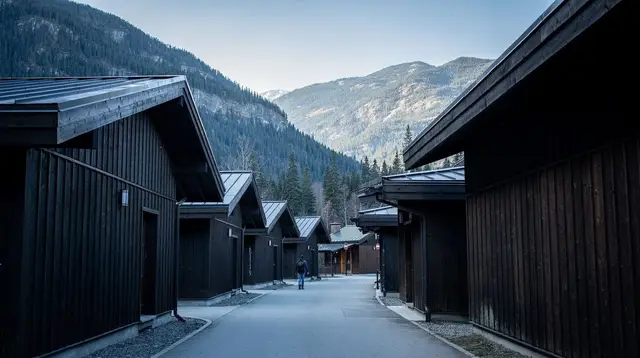
The single biggest advantage Whistler has on a wet day is Whistler Village itself. It is fully pedestrian — cars stay in the parkades at the edges — and small enough that the entire Village Stroll takes about 15 minutes to walk end to end, awning to awning, shop to restaurant to gondola base. That density matters more in the rain than in the sun: everything worth doing on a bad-weather day is within a short, mostly covered walk of everything else, so you’re never committing to a long drive to find out an activity is a washout.
It’s worth knowing why the village looks the way it does. There’s no historic old town to wander, no century of layered architecture, because there wasn’t a town here to build on. The Resort Municipality of Whistler was incorporated in 1975, and the pedestrian village core was built from scratch between 1978 and 1980, on what had been a municipal landfill.
That’s not a knock on the place — it’s the reason the whole centre works so well as a rainy-day base: wide, planned, covered pathways, retail and restaurants stacked close together, and everything oriented toward moving people on foot regardless of the weather. If that history interests you, Whistler Village has no old town, and that’s fine goes into more detail, and skip the rental car — Whistler Village is pedestrian-only explains why you won’t miss a car even on a soaked afternoon.
Museums and cultural sites: the reliable core
Whistler’s museum offering is small but genuinely good, and none of it depends on the sky. The Audain Art Museum, opened in 2016, holds one of the strongest collections of British Columbian art anywhere, including Northwest Coast masks and works by Emily Carr, in a purpose-built gallery a short walk from the village core. Our guide to what you’ll actually see there covers the collection room by room, which is worth reading before you go if you only have an hour.
The Squamish Lil’wat Cultural Centre, opened in 2008, is the shared cultural space of the Squamish (Sḵwx̱wú7mesh) and Lil’wat (Líl̓wat) Nations, on whose unceded shared territory Whistler sits. It’s not a quick five-minute stop — plan on an hour or more if you want the guided tour, which is the better option most visitors choose. Our visit guide lays out what’s included and how to book ahead on a busy day.
If you’re willing to drive about 40 minutes south toward Squamish, the Britannia Mine Museum at Britannia Beach is a National Historic Site built around a former copper mine — one of the largest in the British Commonwealth in its day — with an underground train ride and a sound-and-light show inside its enormous concentrator building. It is, by design, an indoor and underground attraction, which makes it one of the most rain-proof stops on the whole Sea to Sky Highway. The underground train tour guide has the practical details.
Warm up at the spa
A wet, grey day is arguably the best possible day to book Scandinave Spa, the Nordic-style hydrotherapy circuit in the forest north of the village. The hot-cold-rest cycle — sauna or steam, a plunge in cold water, then rest — was never meant to be enjoyed under blue sky; rain on the roof of an outdoor hot pool is, if anything, part of the appeal for a lot of regulars. Our hydrotherapy basics guide explains how the circuit works if you’ve never done one, including the silence policy that surprises first-timers.
Indoor games, arcades and axe throwing
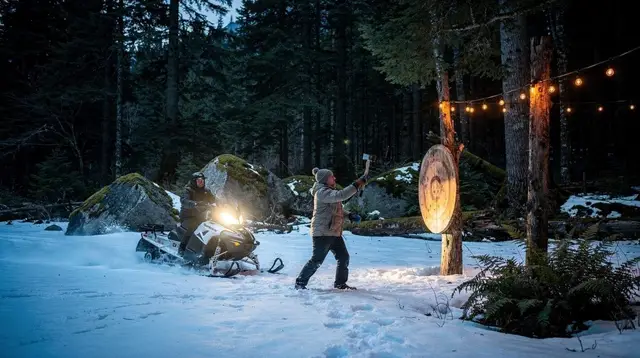
Whistler’s activity catalog includes a genuine bucket of indoor, adults-and-kids-alike options for exactly this kind of day: escape rooms, an arcade, bowling in some seasons, and axe throwing, which shows up specifically as an indoor rainy-day fallback in the village’s own activity listings. It’s a reasonable pick precisely because it doesn’t care what’s happening outside.
One caution worth stating plainly: axe throwing is not automatically open to all ages. Individual venues set their own minimum-age and supervision policies, and none of that is standardized or fixed across operators — some allow younger participants with a parent or guardian present, others set a firm adult-only cutoff. Don’t build a family afternoon around it on the assumption that everyone in your group can take a turn; confirm the age policy with the specific venue before you arrive, especially if you’re travelling with kids or teens.
Tours that aren’t actually weather-dependent
Not every booked activity in Whistler depends on clear skies. A handful were built for conditions that already include getting wet, cold, or both, which makes them a sound rainy-day booking rather than a gamble.
The Whistler Sliding Centre, built for the 2010 Winter Olympics’ bobsleigh, luge and skeleton events, still runs public bobsleigh experiences on its refrigerated, largely enclosed track. Rain on the valley floor doesn’t touch what happens on the ice above it. If you want the full push-start experience with a professional pilot rather than the self-guided public runs, the Whistler private bobsleigh experience runs on the same Olympic legacy track and is a strong pick precisely because a wet forecast doesn’t change the plan.
There’s a warm-weather equivalent too: the summer bobsleigh ride uses wheeled sleds on the same course between roughly May and October, so it fills the same rainy-afternoon slot outside ski season. For the background on how the track and the public program work, see the public bobsleigh experience guide.
In winter, snowmobiling is another activity that doesn’t stop for rain in the valley, because you’re operating above the snow line where the same system is falling as fresh snow rather than rain. A beginner-friendly snowmobile tour into the backcountry works on plenty of days that would cancel a hike or a scenic viewpoint stop lower down.
Whitewater rafting is the other honest rain-proof booking, for the simple reason that you’re already going to get soaked. A whitewater rafting run on the Green River doesn’t lose anything to a grey sky or a passing shower — wetsuits and splash jackets are standard kit regardless of the forecast, and river flow is often better after rain, not worse.
Before booking any tour on a day with a mixed forecast, check its specific weather and cancellation policy — operators differ, and some outdoor activities genuinely do pause for lightning or high wind even when they otherwise tolerate rain.
The gondolas still run
It’s a common assumption that a cloudy or rainy day grounds the lifts. In practice, the PEAK 2 PEAK Gondola — the enclosed cabin linking Whistler and Blackcomb mountains, in operation since December 2008 — keeps running through light and moderate rain, and through cloud, since the cabins are fully enclosed. What you lose on a socked-in day is the view across the 3-kilometre unsupported span between towers; what you keep is a genuinely dry, 11-minute ride between two mountains, which is still worth doing if you’re staying near the base and want to say you’ve done it.
The length, height and ride time guide has the full numbers if you want to know exactly what you’re riding over. Do check conditions before heading up, since heavy wind or an electrical storm — more common than most visitors expect in the Coast Mountains in shoulder season — can pause service on short notice.
Evenings and food don’t need good weather at all
Some of Whistler’s best-regarded activities are built for the dark and don’t care about daytime rain at all. Vallea Lumina, the night-time multimedia walk through the forest north of the village, runs on a set path with its own lighting design, and a light rain barely changes the experience — bring a rain jacket rather than rescheduling. Our guide for visiting with kids covers pacing and what to expect on the trail.
Dinner, too, is an easy rainy-day win in a village this dense with restaurants. If you want to turn a washed-out afternoon into a structured food outing, a self-guided culinary pass across several village restaurants is a practical way to fill hours that would otherwise have gone to an outdoor plan — see the self-guided culinary pass guide for how that works in practice.
Building a full rainy-day plan
A single wet day is easy to fill improvising from the list above. A full rainy stretch — two or three days of the same coastal system parked over the corridor, which does happen, especially in November and early spring — is better handled with a real backup plan rather than day-by-day scrambling. If you’re visiting outside peak ski season and want a structure that assumes some non-ski, weather-flexible days from the start, the Whistler winter without skiing itinerary was built around exactly that kind of flexibility, mixing museums, spa time and weather-proof tours across several days.
If you’d rather browse everything indoors and under cover in one place before committing to a plan, the museums and culture category rounds up the Audain Art Museum, the Squamish Lil’wat Cultural Centre and the Britannia Mine Museum together, which is the fastest way to build a half-day or full-day rainy plan without cross-referencing separate pages.
The short version: a wet forecast in the Sea to Sky corridor is an inconvenience, not a reason to cancel. Base yourself in the village, lean on the museums, the spa and the covered walkways, and book the handful of tours — bobsleigh, snowmobiling in winter, rafting — that were never weather-dependent in the first place.
FAQ: what to do in Whistler when it rains
Does it rain a lot in Whistler?
Yes, especially at village elevation in autumn and early winter, when the coast pushes wet systems up the Sea to Sky corridor. Higher on the mountains the same system often falls as snow, so a wet day in the village can still mean a good ski day above the clouds.
Is Whistler Village worth visiting if the weather is bad?
Yes. Whistler Village is pedestrian, fully covered by awnings along much of the Village Stroll, and small enough to walk end to end in about 15 minutes, so moving between shops, restaurants and indoor attractions in the rain is easy.
Why doesn’t Whistler Village have an old town?
Because there wasn’t one to preserve. The village was purpose-built between 1978 and 1980 on a former municipal landfill, so its pedestrian core is a planned 1980s resort centre rather than a historic settlement.
Does the PEAK 2 PEAK Gondola run in the rain?
Yes, the PEAK 2 PEAK Gondola operates in light-to-moderate rain and cloud, though heavy wind or lightning can suspend service. Cabins are enclosed, but the view across Fitzsimmons Valley will be limited if cloud sits low.
Can you go axe throwing in Whistler?
Axe throwing appears as an indoor option in Whistler’s activity catalog and is a reliable rainy-day pick. Age policies vary by operator and are not fixed, so confirm the minimum age and any parent or guardian requirements directly with the venue before you plan around it.
Are there tours that still run when the weather is poor?
Several do, because they are not sightseeing-dependent. Bobsleigh runs at the Whistler Sliding Centre, snowmobile tours in winter, and whitewater rafting all operate in rain, since participants are already dressed for the elements or riding an enclosed track.
What should I do first if my outdoor plan gets rained out?
Check the specific activity’s weather policy and cancellation window, then default to Whistler Village: the Audain Art Museum, the Squamish Lil’wat Cultural Centre, Scandinave Spa and a covered lunch are all within easy walking distance of each other.
Adventure Parks on GetYourGuide
Verified deep-linked GetYourGuide tours. Book through these links and we earn a small commission at no cost to you.
GetYourGuide does not provide a product photo for this activity — the image shows the meeting point, photographed by us.