Panorama Ridge: How Long Does the Hike Really Take?
How long is the Panorama Ridge hike compared to Garibaldi Lake?
Panorama Ridge is roughly 30 km round trip with about 1,500 m of cumulative elevation gain, well beyond the shorter hike to Garibaldi Lake alone. Most hikers need 10 to 14 hours car to car, or spread it over two days from a campground, and a BC Parks day-use pass is required in high season before you drive up.
Why this is not just “the Garibaldi Lake hike, a bit longer”
Every year, hikers who researched the trail to Garibaldi Lake and decided to push on to Panorama Ridge discover, somewhere past the lake, that they underestimated the day by a wide margin. The two hikes share a trailhead and the first stretch of trail, and it is tempting to treat the ridge as a modest add-on. It isn’t. Garibaldi Lake on its own is a serious but containable day; Panorama Ridge, reached from the same Garibaldi Provincial Park access point, is a different order of commitment — roughly 30 km round trip, with elevation gain that keeps accumulating well past the point where the lake hike would normally end.
This page exists to answer one question honestly: how long and how hard is this, really, compared to stopping at the lake. It does not walk through the lake trail itself step by step — that route, its junctions and its own pass requirements are covered on the Garibaldi Lake hike guide — and it does not cover the scramble up Black Tusk, which splits off from the same approach onto its own line and its own page. What follows is specific to the ridge itself: the numbers, the realistic time on your feet, and the planning step that trips up more people than the distance does.
The numbers, without rounding them into something friendlier
The round-trip distance most commonly cited for Panorama Ridge from the Rubble Creek trailhead is close to 30 km. Cumulative elevation gain — counting not just the climb up but the smaller ups and downs on the rolling section beyond the lake, plus the final pull to the ridge itself — lands in the region of 1,500 m. Those two figures together are what separate this hike from almost everything else accessible as a day trip from Whistler or Squamish.
It helps to see the contrast next to the two hikes it gets compared to constantly:
| Hike | Round trip distance | Cumulative elevation gain | Typical structure |
|---|---|---|---|
| Garibaldi Lake only | ~18 km | ~800 m | Single climb, defined endpoint at the lake |
| Panorama Ridge | ~30 km | ~1,500 m | Climb to the lake basin, then extended rolling terrain to the ridge |
| Black Tusk (from the same trailhead) | ~27 km | ~1,700 m | Similar approach, then a steep scramble near the summit |
Both figures for Panorama Ridge deserve a second look, because they are frequently where people go wrong in their planning. The distance alone would be a long day for most hikers even on flat ground. Add 1,500 m of gain — more than the vertical drop of Blackcomb’s own ski runs — spread over undulating alpine terrain with no shade for most of the upper section, and the honest comparison is not “Garibaldi Lake plus a bit more.” It is closer to two demanding hikes stacked on the same day.
Why no one should tell you a fixed number of hours
Ask five hikers who have done Panorama Ridge how long it took them and you will get five different answers, and every one of them will be honest. Pace on a 30 km alpine day depends on fitness, how much weight is on your back, how many photo stops the ridge itself demands (it earns them), trail conditions from the season’s snowpack, and whether you are racing the light on the way down. Ranges commonly reported by hikers who have done the full return in a single push run from around 10 hours for a fit, fast, unencumbered party to 14 hours or more for a more typical pace with a proper lunch stop at the top.
Treat any number you read — including the range above — as a planning input, not a promise. The one number that matters more than any of these is your turnaround time: decide before you leave the car what time you will turn back regardless of how close to the ridge you are, and hold to it. On a route this long, an unplanned descent in the dark on tired legs is the actual risk, not the distance itself.
Because of that variability, most parties who complete the full round trip either start extremely early — well before sunrise in midsummer — or split the effort over two days using one of the park’s backcountry campgrounds, discussed below.
Where the distance and elevation actually accumulate
The trail from Rubble Creek climbs in switchbacks through forest for the first several kilometres — the steepest sustained section of the entire day — before the grade eases near the Taylor Meadows and Garibaldi Lake junction, roughly 9 km in. This first stretch alone accounts for a large share of the day’s total elevation gain, which is exactly why hikers who stop at the lake feel they have already done a full hike.
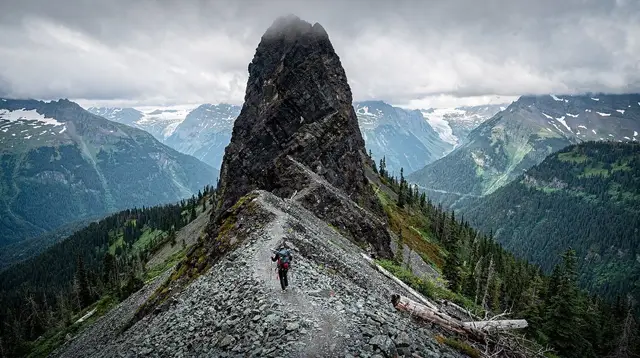
Past that junction, the trail toward Panorama Ridge does not simply flatten out. It rolls across open meadow and rock benches above the lake, gaining and losing elevation repeatedly rather than climbing in one clean line — which is part of why the cumulative gain figure is meaningfully higher than a simple trailhead-to-summit elevation difference would suggest. The final approach to the ridge itself is a sustained, exposed climb with no tree cover, delivering the payoff views over the turquoise lake and the glaciated slopes of the Black Tusk massif, but also delivering the last and often most tiring push of the day when legs are already well used.
The return is the same distance and the same cumulative descent, which on tired knees after an already long day is its own kind of demanding. Budget realistic time for the way down; it is common for it to take nearly as long as the ascent once fatigue sets in.
The permit step that comes before any of this
Before any of the distance or timing planning matters, there is a gate that has to be cleared first: BC Parks manages access to the Rubble Creek trailhead in Garibaldi Provincial Park with a free, timed day-use pass system during the busy summer season, booked online ahead of your visit. This is the same kind of system that governs access to Joffre Lakes further north, and it exists because trailhead parking and trail capacity are genuinely limited on peak summer weekends.
The specifics — which months require a pass, how far ahead booking opens, and whether any exemptions apply — change from year to year, and this page will not repeat a number that could be wrong by the time you read it. What will not change is the instruction: check the official BC Parks page for Garibaldi Provincial Park before you commit to a date, not the night before. A closed booking window or a sold-out day at the end of a long drive up the Sea to Sky corridor from Vancouver is an expensive way to learn this lesson.
Splitting it over two days
Given the numbers above, a large share of hikers who reach Panorama Ridge do not attempt the full 30 km in a single push. Instead, they camp at Taylor Meadows or the Garibaldi Lake campground — both roughly 9 km from the trailhead — the night before, then do an out-and-back day hike to the ridge and back the next morning before packing out. That structure cuts the single hardest day down to roughly 12 km return with a lighter pack, at the cost of carrying camping gear in on day one and needing a separate backcountry camping reservation, booked independently of the day-use pass and often well in advance for summer weekends.
This is a genuinely good option for hikers who want the ridge without the single marathon day, and it is worth planning around if your schedule and gear allow for it. It is also, unavoidably, a different trip to organize than a day hike: more logistics, more advance booking, and a heavier pack for the first stretch.
Season, conditions, and what changes them
Panorama Ridge is generally accessible from around mid or late July through September, but that window moves with each winter’s snowpack — a heavy snow year can keep the upper approach under snow well into July, while a light one can open it earlier. This is one of several reasons the trail is not something to plan around a single guaranteed date months out. Once the season turns in September and October, shortening days and the first alpine snow bring the window to a close, usually with little warning.
Outside of that rough window, expect a trail that is unmaintained for winter travel and increasingly exposed to the same weather that closes the alpine terrain around Garibaldi Lake and Black Tusk to casual hikers. Afternoon thunderstorms are a real hazard on the open ridge in summer; starting early is as much about avoiding weather as it is about the distance.
What to carry for a day this long
Beyond standard alpine hiking gear — layers, a hard shell against wind on the exposed ridge, sturdy footwear, and a map or offline GPS track since phone signal disappears well before the lake — the distance itself changes the calculation on water and food. Plan for meaningfully more than a shorter hike would need, since there is limited reliable water access on the rolling section past the lake junction. A headlamp is not optional gear for this hike; even a well-paced party has a real chance of finishing the last stretch in fading light, and an unplanned late finish without one turns a long day into a genuinely risky one.
If the full distance doesn’t fit your day
Not every visitor to the park needs to reach the ridge itself to have a full day out. Garibaldi Lake alone, at roughly 18 km return, is a complete and rewarding hike on its own terms, covered step by step on its own guide.
Hikers who want alpine scenery with a shorter and gentler profile sometimes choose Cheakamus Lake instead, a flatter, lower-elevation walk in the same park that trades the ridge’s payoff view for a far more manageable day — detailed in the guide to that easier alternative. And for those who want the Rubble Creek approach but a scramble finish rather than a long traverse, the trail to Black Tusk splits off the same corridor with its own distinct demands.
Doing it guided instead of solo
Given the permit system, the navigation on the rolling section past the lake, and the value of a set turnaround time enforced by someone other than your own optimism at 6 a.m., a guided day trip removes a meaningful share of the planning risk. A guided hike to Panorama Ridge with transport included handles the pass logistics and pacing, which matters on a route this unforgiving of a late start.
Groups coming from the Whistler or Squamish side sometimes prefer a guided Garibaldi Park hike departing from Squamish or Whistler, while others booking from a Vancouver base look at a full-day guided trip into the park with Panorama Ridge as the objective.
None of these guided options change the physical numbers above — the distance and the elevation gain are the same whether you are hiking with a guide or alone — but they do remove the parts of the day that trip people up most: booking the pass correctly, keeping pace against a real turnaround time, and navigating the rolling section past the lake without wasting energy on route-finding.
Planning the rest of the trip around this hike
Because this is a full day — or two, if camping — it rarely stands alone in a Whistler itinerary. If you’re building alpine hiking into a longer stay, the alpine hiking week in Whistler itinerary sequences a day like this alongside shorter recovery hikes, and the broader hiking trails category lists every other trail option in the area if you want a lighter day either side of this one.
For timing your visit more generally against snow, crowds and weather, see the guide on the best time to visit Whistler and the practical note on how many days you need in Whistler if Panorama Ridge is one piece of a bigger trip.
Anyone still deciding between this hike and its most common alternative should read the direct comparison of Garibaldi Lake against Joffre Lakes, which covers the trade-offs between the two parks’ flagship hikes, including the pass systems each one runs under — a useful read given how similarly BC Parks manages both, as explained in the Joffre Lakes permit and closures guide.
Panorama Ridge, in one line
This is not the Garibaldi Lake hike with a short extension bolted on. It is close to 30 km round trip with roughly 1,500 m of cumulative elevation gain, a full and serious alpine day by any measure, and one that deserves an early start, a hard turnaround time, and a checked BC Parks day-use pass before the car leaves the driveway.
Panorama Ridge hike: frequently asked questions
How long is the Panorama Ridge hike round trip?
About 30 km return from the Rubble Creek trailhead, with roughly 1,500 m of total elevation gain once the climb back out of the Taylor Creek valley is counted. It is one of the longest day hikes commonly attempted in the Sea to Sky corridor.
Is Panorama Ridge harder than the hike to Garibaldi Lake?
Yes, substantially. Garibaldi Lake alone is around 18 km return with about 800 m of gain and a defined end point. Panorama Ridge continues well past the lake on rolling, exposed terrain, roughly doubling the distance and adding hundreds more metres of climbing.
Do I need a permit or day-use pass for Panorama Ridge?
Yes. BC Parks requires a free timed day-use pass for Garibaldi Provincial Park’s Rubble Creek access in the busy season, booked online in advance. Check the current BC Parks page before you drive up, since the rules and season dates are adjusted from year to year.
Can I camp partway to break up the distance?
Yes, and many hikers do. Taylor Meadows and Garibaldi Lake campgrounds sit roughly 9 km in, cutting the ridge day itself down to about 12 km return. Both require a separate paid backcountry camping reservation booked well ahead, on top of the day-use pass system.
When is Panorama Ridge open and snow-free?
Typically from mid or late July through September, though this shifts every year with snowpack. Snow can linger on the upper approach into July, and the route is not maintained or patrolled once the shoulder season ends, so always check current trail reports.
Is Panorama Ridge suitable for beginners?
Not as a first big hike. The distance and cumulative elevation gain call for solid fitness, an early start, and real experience judging pace and turnaround time on an exposed alpine trail with no shortcuts back to the car.
Should I do Panorama Ridge or Black Tusk instead?
They start on the same trail but split into different objectives, each covered on its own page. Panorama Ridge is longer with more sustained elevation gain; the Black Tusk approach adds a steep scramble near the top. Neither is a lesser version of the other.
Is there a guided option if I don’t want to hike it solo?
Yes. Guided day tours into Garibaldi Provincial Park handle transport, pacing and permits, which removes most of the planning risk on a route this long, though the distance and elevation gain are unchanged whoever is leading.
Hiking on GetYourGuide
Verified deep-linked GetYourGuide tours. Book through these links and we earn a small commission at no cost to you.
GetYourGuide does not provide a product photo for this activity — the image shows the meeting point, photographed by us.