A Guided First Nations Heritage Tour in Whistler: What It Actually Covers
What does a guided First Nations heritage tour in Whistler include?
It is a guided outing led with reference to Squamish and Lil'wat culture and history, distinct from simply walking through the Squamish Lil'wat Cultural Centre on your own. It combines the landscape and story of Whistler with the perspective of the two Nations whose shared, unceded territory the resort sits on, rather than staging any kind of performance or re-enactment.
A different kind of Whistler tour
Most first-time visitors search for a museum to tick off, and land on the Squamish Lil’wat Cultural Centre in the Upper Village. That museum is worth its own unhurried visit — see our separate Squamish Lil’wat Cultural Centre guide for that.
This page covers something the booking inventory lists as a distinct product: a guided tour built around the spirit of Whistler and First Nations heritage, which is a guided outing through the valley with a guide, not a self-directed walk through gallery rooms. Confusing the two is the single most common mistake in planning this part of a Whistler trip, so it is worth being precise about what each one is before you book anything.
A guided heritage tour puts a person in front of you for the length of the activity: someone who can point at Whistler Mountain or the shoreline of Alta Lake and speak to what that place has meant, and still means, to the communities who have lived here for thousands of years — well before the ski resort, the Village Stroll or the Highway 99 corridor existed. It is conversation and interpretation moving through the landscape, not a static exhibit you walk past at your own pace.
Whose land Whistler actually sits on
Every version of this kind of tour starts from the same fact, and it is worth stating plainly rather than treating as a footnote: Whistler sits on the shared, unceded territory of the Squamish Nation (Sḵwx̱wú7mesh) and the Lil’wat Nation (Líl̓wat). “Unceded” is a specific word, not a courtesy — it means this land was never surrendered by treaty. The two Nations have occupied and stewarded this valley, the surrounding mountains and the wider Sea to Sky corridor for millennia, long before the Resort Municipality of Whistler was incorporated in 1975 or the first lifts went up on Whistler Mountain and Blackcomb Mountain.
That shared territory is also unusual on its own terms: the Squamish and Lil’wat Nations are historically distinct peoples, with different languages and traditions, who share this particular stretch of land and have built a joint institution together rather than being lumped together by outsiders. A guided heritage tour is one of the few formats in Whistler that puts that fact in front of a visitor directly, in the place it actually happened, instead of compressing it into a single line on a hotel brochure.
The Cultural Centre is their own museum — and it is a separate visit
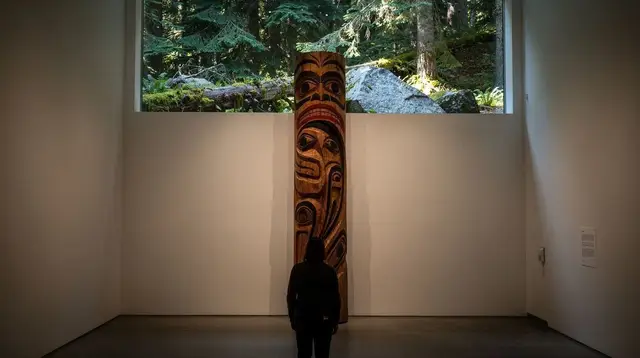
It matters that the Squamish Lil’wat Cultural Centre, which opened in 2008 in the Upper Village, is not a resort attraction built for tourists by a third party. It is the two Nations’ own museum, designed, built and staffed by Squamish and Lil’wat community members, holding their own canoes, cedar weaving, carving and oral history on their own terms. A visit there deserves real time and its own itinerary slot — we cover that fully in the Cultural Centre visit guide, including how long to budget and what not to rush.
A guided heritage tour is a different product from that museum visit, even when both touch the same two Nations. Where the Cultural Centre is a building you explore at your own pace, a guided tour moves through Whistler’s outdoor landscape with an interpreter alongside you the whole time, weaving in history, place names and living culture as you go rather than reading it off a wall panel. Treat the two as complements on a trip, not substitutes for each other — many visitors do the guided tour on one day and the museum, unhurried, on another.
What a guided tour like this actually involves
Formats differ by operator and season, but a legitimate Whistler heritage tour built around Squamish and Lil’wat culture generally shares a few things in common:
- A guide with a real connection to the material. Reputable tours are delivered in partnership with, or directly led by, Squamish or Lil’wat guides and cultural interpreters — not a general sightseeing guide reciting facts secondhand.
- Movement through real places, not a stage. Expect walking through parts of the village and its surrounding landscape, with stops for storytelling, place names and context, rather than a seated show in one room.
- Living culture, not costume. The material covers history, land relationship, language and ongoing traditions as they exist today — this is presented as a living, continuing culture, never as a historical re-enactment or a folklore performance staged for an audience.
- A conversation, not a monologue. Good heritage guiding leaves room for questions, and does not rush past difficult parts of the history to keep things comfortable.
If a tour or an operator ever describes this experience using words like “reenactment,” “authentic native show” or anything staged for entertainment, that is a signal to look elsewhere — genuine cultural interpretation and performance-for-tourists are not the same thing, and the difference matters both ethically and for what you actually get out of the morning.
How it compares with other ways to spend that half-day
| Option | Format | Best for |
|---|---|---|
| Guided First Nations heritage tour | Small-group, guided, moves through the landscape | Visitors who want context and conversation, not just exhibits |
| Squamish Lil’wat Cultural Centre on your own | Self-paced museum visit | Visitors who want to spend real time with objects and exhibits |
| Squamish Lil’wat Cultural Centre visit guide | Planning reference for the museum | Deciding how long to budget and what to prioritise inside |
Pairing it with the rest of a Whistler day
A guided heritage tour usually runs as a half-day activity, which leaves room to build a full day around it without overloading anyone. A common, comfortable combination looks like this:
- Morning — the guided heritage tour itself, while energy and attention are freshest.
- Midday — lunch in Whistler Village; a guided multi-course progressive lunch through several village restaurants works well if you would rather not choose just one spot, and our progressive lunch guide covers what to expect from that format.
- Afternoon — something active and unrelated, such as a lakeside walk around Lost Lake or a ride on the PEAK 2 PEAK Gondola, so the day does not feel like one long lecture.
- Evening — for families, a hands-on carving art class for kids aged eight and up is a gentle, age-appropriate way to extend the day’s cultural theme without asking children to sit through another guided talk; see our roundup of Whistler multi-activity day packages for how that slots into a longer itinerary.
For a different kind of evening entirely, the after-dark forest walk Vallea Lumina, Whistler’s multimedia night walk through the forest is unrelated to First Nations heritage programming and should not be confused with it — it is a separate, purely visual light-and-sound experience, covered in our Vallea Lumina with kids guide.
Visitors who prefer an active, outdoor-first way to spend time in this same landscape, guided by someone who knows the terrain well, might instead look at a guided wilderness hike around Whistler’s lakes and forest, which is a nature-focused format rather than a culture-focused one — see our broader hiking trails category for the full range of guided and self-guided options in the valley.
Booking, timing and what to bring
Guided cultural tours in Whistler typically run in small groups with limited daily departures, so book ahead rather than assuming you can walk up, particularly during the busy December-to-March winter season and the July-to-August summer peak. Dress for the outdoors regardless of season — most of the walking happens outside, not in a heated hall — and bring the same layers you would for any Whistler Village walk: closed shoes, a light waterproof layer, and water. Cameras are generally welcome, but ask your guide before photographing any specific object, artwork or person, since not everything shared on a cultural tour is meant to be reproduced freely.
Budget-wise, a guided half-day heritage experience sits in the same general bracket as other guided small-group activities in Whistler — worth weighing against the value of the rest of your trip. Our Whistler budget guide and how many days do you need in Whistler pages are useful companions when you are deciding how a cultural morning fits against ski, hiking or gondola spending elsewhere in your itinerary.
For first-time visitors building a full plan around Whistler village, our two-day first-timer itinerary shows where a half-day cultural activity like this typically sits in a wider schedule.
Why two distinct Nations share this one territory
The Squamish and Lil’wat Nations are not variations on a single culture placed side by side for convenience. Squamish is a Coast Salish people whose language, Sḵwx̱wú7mesh sníchim, belongs to the coastal language family; Lil’wat is part of the St’at’imc (Interior Salish) world, and its language, Ucwalmícwts, is unrelated to Sḵwx̱wú7mesh.
What ties the two together in this specific valley is geography rather than ancestry: the Whistler-Pemberton corridor sat on a travelling and trading route linking the coast to the interior, and this stretch of land functioned as a shared meeting ground long before it was a resort. A guided heritage tour is one of the only formats that explains this distinction on the ground, rather than letting visitors assume “First Nations” means one undifferentiated culture.
The physical side, and what a guide will and will not show you
A heritage tour is walking-paced interpretation, not a hike: expect gently graded paths through the village and its immediate surroundings, manageable for most visitors including those who would not attempt a mountain trail, though anyone with significant mobility limitations should ask an operator directly about terrain before booking. Outdoor portions generally proceed through light rain, since Whistler’s weather changes quickly in any season; dress for it rather than expecting a fallback indoor plan.
Expect to hear place names and words in Sḵwx̱wú7mesh sníchim and Ucwalmícwts for features you can see from the path — a different way of encountering the valley than reading a translated caption at the Cultural Centre. Guides are also selective about what they share on request, and that is by design, not an oversight:
- Some songs, crests, family histories and ceremonial objects belong to specific families or houses within each Nation and are not shared publicly, on a tour or anywhere else.
- Photography of people, ceremonial items or specific artwork should be asked about individually rather than assumed to be fine because photography in general was welcomed.
- A guide declining to go into detail on something is a boundary being respected, not a gap in the tour, and should not be read as reluctance to engage.
Groups tend to stay small enough for a guide to talk with everyone directly rather than address a crowd, which is part of why advance booking matters more than it would for a larger, fixed-capacity attraction.
Frequently asked questions about the Whistler First Nations heritage tour
Is this the same thing as visiting the Squamish Lil’wat Cultural Centre?
No. The Cultural Centre is a standalone museum that Squamish and Lil’wat community members built and run themselves, and it has its own separate visit. A guided heritage tour is a different, bookable format that puts a guide alongside you through Whistler’s landscape and history rather than through gallery rooms.
Whose land is Whistler actually on?
Whistler sits on the shared, unceded territory of the Squamish Nation (Sḵwx̱wú7mesh) and the Lil’wat Nation (Líl̓wat). Neither Nation ceded this land by treaty, and both continue to hold and assert rights and title across the valley and the wider Sea to Sky corridor.
Is a First Nations heritage tour a staged performance?
No, and it should never be sold or understood as one. A genuine heritage tour is guided interpretation and conversation grounded in real history and living culture, not a costumed re-enactment or a folklore show put on for visitors.
Who leads these tours?
Reputable heritage tours in Whistler are delivered in partnership with, or led by, Squamish or Lil’wat guides and cultural interpreters, rather than by generic sightseeing operators reciting secondhand facts.
How long does a guided heritage tour take?
Formats vary by operator, but most guided cultural and heritage outings in Whistler run as a half-day activity, leaving the rest of the day free for a mountain activity or a meal in the village.
Should I also visit the Cultural Centre if I take a guided tour?
Yes, the two are complementary rather than duplicates. The guided tour gives you a wider sense of place and living context; a separate, unhurried visit to the Cultural Centre lets you spend real time with its exhibits and its own staff at your own pace.
Do I need to book in advance?
Guided cultural experiences in Whistler run in limited small-group departures, so booking ahead is worth doing, especially in the busy December-to-March and July-to-August windows.
Museums & Culture on GetYourGuide
Verified deep-linked GetYourGuide tours. Book through these links and we earn a small commission at no cost to you.
GetYourGuide does not provide a product photo for this activity — the image shows the meeting point, photographed by us.