What's Inside the Audain Art Museum Collection
What is in the collection at the Audain Art Museum?
The Audain Art Museum, which opened in Whistler in 2016, holds one of the strongest collections of British Columbian art anywhere, from historic Northwest Coast masks and carvings to paintings by Emily Carr and generations of artists who followed her. It is a single, purpose-built museum, entirely separate from the nearby Squamish Lil'wat Cultural Centre.
Whistler is not a place most travellers associate with fine art, which is exactly why the Audain Art Museum tends to surprise people. Tucked into the trees on the edge of Whistler Village, it opened in 2016 to house one of the strongest collections of British Columbian art anywhere in the province — built, gallery by gallery, around a single private collector’s decades of buying. This guide sticks to one question: what is actually on the walls, from the Northwest Coast masks to the Emily Carr canvases, and what it is not — namely the Squamish Lil’wat Cultural Centre, a different institution nearby with its own story to tell.
A Private Collection Made Public
The Audain Art Museum exists because one person decided a private collection should not stay private. Michael Audain, a Vancouver-based developer and long-time patron of British Columbian art, spent decades acquiring paintings, carvings and masks, and in the early 2010s committed both the art and a significant part of the funding to build a museum around it in Whistler. The building opened its doors in 2016, designed by the Vancouver firm Patkau Architects and raised on stilts above the surrounding land — a practical response to the site’s floodplain, and a visual one too, since the museum reads as a long, low form floating just above the forest floor.
Unlike a civic gallery that assembles a collection from many donors over a century, the Audain is unusually coherent: nearly everything inside traces back to one collector’s eye and one clear mandate, to represent British Columbian art specifically rather than art in general. That focus is what makes the museum worth a stop even for visitors who normally skip museums on a ski or hiking trip — it does one thing, and does it with depth rather than breadth.
What the Collection Actually Covers
The collection spans roughly two and a half centuries of art made in or about British Columbia, organized loosely by period as you move through the galleries. It is not a broad, general-purpose art museum; everything on the walls has a British Columbian thread running through it, whether that is the artist’s origin, subject matter, or both.
| Period | What’s on show |
|---|---|
| Historic Northwest Coast | Ceremonial and transformation masks, carved panels, argillite and wood works |
| Late 19th–early 20th century | Emily Carr’s forest and totem-pole paintings, related contemporaries |
| Mid-20th century | Modernist BC painters working in landscape and abstraction |
| Contemporary | Photography, painting and sculpture by living BC artists |
Because the collection is privately assembled rather than institutionally acquired, its emphasis is uneven in a deliberate way — some periods get a single strong room, others get several, following where the original collector’s interest ran deepest. That unevenness is part of what gives the museum its character rather than a flaw to apologize for.
The Northwest Coast Masks
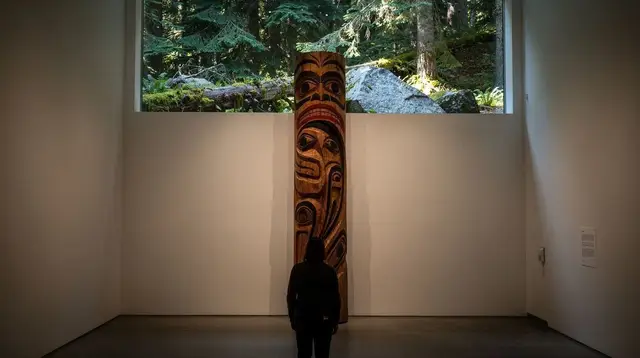
The museum’s most talked-about gallery holds its collection of Northwest Coast masks, one of the strongest assemblies of this material on public display anywhere. These are original carvings — ceremonial masks, transformation masks that open to reveal a second face inside, and related carved objects — made by Northwest Coast Indigenous artists across a long span of time, from historic pieces to newer works by contemporary carvers working within the same traditions.
The room is kept deliberately dim, both to protect the wood and pigment and to focus attention: masks are lit individually rather than under bright, even gallery lighting, and the effect is closer to encountering ceremonial objects in a dark space than browsing a well-lit exhibit case. Wall text explains form and technique — how a transformation mask is carved and strung so it can open — without attempting to substitute for the living cultural context that belongs to the Nations themselves.
That distinction matters: the masks are shown here as art, in an art museum’s frame, and the deeper cultural and ceremonial meaning behind Northwest Coast art forms is the subject the Squamish Lil’wat Cultural Centre exists to tell, in the Nations’ own words, at their own dedicated building nearby. The two rooms — and the two institutions — are not substitutes for each other, and a visitor who wants the fuller picture benefits from seeing both rather than treating one as covering the other.
Emily Carr at the Audain
The second anchor of the collection is Emily Carr, the Victoria-born painter whose forest interiors and Indigenous village and totem-pole subjects made her the best-known British Columbian artist of the early 20th century. The Audain holds a substantial group of her canvases — enough, in most hangs, to fill a gallery of their own — spanning her characteristic subjects: dense, swirling forest canopies, weathered totem poles photographed and painted on her travels along the coast, and the moody, almost abstracted skies of her later work.
Which specific paintings are on the wall shifts with periodic rotations, since works are cycled to manage conservation and to make room for loans and temporary shows, so a specific canvas seen in a photo online is never guaranteed to be up on any given visit. What stays constant is the concentration: rather than two or three Carr paintings scattered among other artists, as in many general galleries, the Audain gives her work room to be seen as a body rather than a footnote.
Beyond Carr: The Rest of the 20th and 21st Centuries
Past the Carr and mask galleries, the collection continues into mid-20th-century British Columbian modernism and on into contemporary work. Expect landscape and abstract painters working through the decades after Carr, followed by rooms of more recent photography and sculpture from living BC artists. The museum also runs a program of temporary exhibitions in a dedicated space, which means the permanent collection is not the whole story on any given visit — a special show, often drawing on loans from outside BC entirely, typically overlaps with the permanent galleries during the ticket window.
For visitors coming from the Audain Art Museum general admission ticket, it is worth checking what temporary exhibition is running before the trip, since it can shift a visit from ninety minutes to considerably longer.
book the Audain Art Museum general admission ticket ahead of a Village afternoon and you can walk in without waiting at the desk, which matters on the busiest weekends of the winter season.
The Building and the Walk Through It
The museum’s architecture is part of the experience rather than a neutral container around it. Raised above grade on the floodplain site, the long single-storey structure is clad in dark, weathering metal, with the entrance approached across a short bridge-like walkway through the surrounding cedar and hemlock forest. Inside, the plan is a straightforward sequence of connected galleries — no confusing wings or repeated backtracking — moving roughly chronologically from the historic Northwest Coast material through Carr and into the contemporary rooms, with the temporary exhibition space usually bracketing one end of the route.
Natural light is used sparingly and only where conservation allows, which keeps the emphasis on the individually lit works rather than the building itself competing for attention. It is a quiet, unhurried space by design, a deliberate contrast to the more active galleries and cultural spaces elsewhere in the resort.
Audain Art Museum vs Squamish Lil’wat Cultural Centre
Because both sit within walking distance of each other in the same part of Whistler, it is easy for a first-time visitor to blur the two together. They are not the same kind of place, and treating one visit as covering the other is the single most common misstep travellers make with Whistler’s museums.
| Audain Art Museum | Squamish Lil’wat Cultural Centre | |
|---|---|---|
| What it is | A fine-art museum built around a private collection | A cultural centre owned and operated by the Squamish and Lil’wat Nations |
| Focus | British Columbian art history, including historic Northwest Coast masks and Emily Carr | The living culture, history and stories of the Squamish and Lil’wat peoples, told in their own voice |
| Opened | 2016 | 2008 |
| Typical visit length | 1.5–2 hours | Roughly similar, often with guided tours available |
Visiting both, rather than assuming one stands in for the other, gives a far more complete picture: the Audain shows Northwest Coast carving as art history within a broader BC collection, while the Squamish Lil’wat Cultural Centre tells the living, first-person story behind that same tradition. A good day plan pairs the two rather than picking one and skipping the other — see our guided First Nations heritage tour for one way to link them with a host who can speak to both.
a Whistler and First Nations heritage tour is one way to see both sides of the story in a single guided outing rather than piecing it together on your own.
Planning a Visit
The museum sits within easy walking distance of the Whistler Village core, on the way toward the Upper Village, so it slots easily into a Village day without needing a car or a bus. Opening hours and ticket prices change periodically, so check the museum’s current schedule before building a tight day plan around it, especially outside the main winter season when hours can be reduced.
A typical visit runs ninety minutes to two hours for the permanent collection alone; add time if a temporary exhibition is running, and more again if you plan to read the wall text carefully in the mask gallery, which rewards a slower pace than the rest of the museum. There is a gift shop near the entrance worth a few minutes, stocked with books on British Columbian art and small pieces by regional artists.
For a rainy day in the Sea to Sky corridor — and Whistler gets its share of them — the Audain is one of the better indoor options precisely because it does not feel like a fallback plan; see our roundup of rainy-day activities in Whistler for others that pair well with it on the same afternoon.
Nearby Things to Do After the Museum
The museum sits close enough to other Village attractions that it pairs naturally with a longer afternoon or evening out. If you are visiting in the colder months, the forest walk of Vallea Lumina makes a striking contrast after an afternoon of quiet gallery rooms — one is still and contemplative, the other a lit, sound-tracked night walk through the trees.
pairing an Audain Art Museum afternoon with the Vallea Lumina night walk turns a single stop into a full day, art in the afternoon and forest lights after dark.
For an evening that keeps the cultural thread going, a number of visitors follow the museum with dinner in the Village rather than rushing back to a hotel room.
a guided dinner tour through Whistler Village’s restaurants is a relaxed way to close out a museum day without having to research where to eat on your own.
If you are travelling with kids and want a hands-on complement to a morning of looking rather than making, a short carving class scratches a similar itch to what you have just seen on the museum walls, using tools sized for younger hands rather than the historic techniques on display.
First-timers building a broader Village itinerary can start from our one day in Whistler Village plan or the wider first-timer’s sightseeing guide, and anyone still weighing how much time to give the resort overall should read how many days do you need in Whistler before committing to a schedule. General planning notes for the trip, from tipping to what to pack, are gathered on our travel tips hub.
Audain Art Museum FAQ
When did the Audain Art Museum open, and why does it exist?
The museum opened in 2016 in Whistler Village. It was built to give a permanent, public home to a private collection of British Columbian art assembled over decades by developer and philanthropist Michael Audain, rather than have it stay behind private doors or scatter to other institutions.
What kind of art does the Audain Art Museum actually hold?
Its focus is British Columbian art specifically, spanning roughly two and a half centuries: historic Northwest Coast masks and carvings, the paintings of Emily Carr, and a run of 20th- and 21st-century BC artists working in photography, painting and sculpture.
Are there real Northwest Coast masks on display, or reproductions?
The masks are genuine historic and contemporary works, one of the museum’s signature holdings. They are original carvings by Northwest Coast artists, displayed as fine art rather than as ethnographic props, in a dedicated gallery with low, careful lighting.
How much Emily Carr work is actually on show?
The museum holds a substantial group of Emily Carr paintings, often enough to fill a full gallery on its own, ranging across her forest and totem-pole subjects. Exactly which canvases are hung changes with rotations, so a specific painting is never guaranteed to be up on a given day.
Is the Audain Art Museum the same thing as the Squamish Lil’wat Cultural Centre?
No. They are two separate institutions a short walk apart in Whistler. The Audain is a fine-art museum built around a private collection; the Squamish Lil’wat Cultural Centre is owned and run by the Squamish and Lil’wat Nations themselves, telling their own history and culture. Neither replaces the other.
How long should I plan for a visit?
Most visitors spend around ninety minutes to two hours moving through the permanent galleries and a temporary exhibition. Add more time if a special exhibition is running, or if you plan to linger in the Northwest Coast mask gallery, which rewards a slow pass.
Is photography allowed inside the museum?
Personal, non-flash photography is generally permitted in the permanent collection galleries, though specific temporary exhibitions sometimes restrict it under loan agreements. Check the signage in each room, since the rule can change exhibition to exhibition.
Museums & Culture on GetYourGuide
Verified deep-linked GetYourGuide tours. Book through these links and we earn a small commission at no cost to you.
GetYourGuide does not provide a product photo for this activity — the image shows the meeting point, photographed by us.