Britannia Mine Museum: The Underground Train Tour and Sound-and-Light Show
What is there to do at Britannia Mine Museum?
Britannia Mine Museum, at Britannia Beach on the Sea to Sky Highway, is a National Historic Site built around a former copper mine. The main experience is a guided ride on the underground train into the old workings, paired with a sound-and-light show inside the 20-storey concentrator building where the ore was once processed.
What the underground train tour at Britannia Mine Museum is really like
Most people drive past Britannia Beach on the way from Vancouver to Squamish or Whistler without registering what it is. A cluster of industrial buildings sits on the shore of Howe Sound, dominated by a tall, dark, timber-framed structure that looks like nothing else on the Sea to Sky Highway. That building is the old concentrator, or mill, and the site around it is Britannia Mine Museum — a National Historic Site built on the footprint of what was, for a stretch of the 20th century, one of the largest copper mines in the British Empire.
This is not a mine you can still watch in operation. Britannia Mine closed in 1974, after decades of extracting copper, along with smaller amounts of gold, silver, lead and zinc, from tunnels that eventually stretched for many kilometres into the mountainside above the highway. What survived closure — the headframe, the mill building, miles of underground workings and a huge stock of original equipment — became, in the years afterward, the basis for a museum rather than a ruin. It is a working museum built inside a dead mine, and understanding that distinction is the key to enjoying the visit: nothing here is being actively mined, but almost everything you see and ride through is original.
Two experiences in one visit: the train and the mill
A visit to Britannia Mine Museum is really built around two separate, guided experiences, and most tickets bundle both.
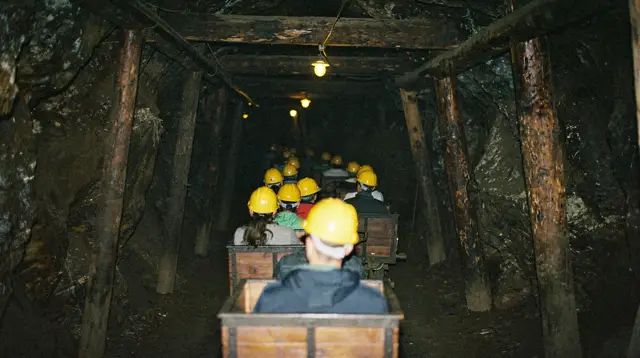
The first is the underground train ride, sometimes marketed as the BOOM! tour. Visitors climb aboard a small train that runs on original rail into a section of tunnel preserved specifically for public access — lit, supported and far shorter than the mine’s full underground network, but built from the same rock and rail as the working mine. A guide in period dress narrates the ride: how tunnels were driven through hard rock, how holes were drilled and charged for blasting, what a shift underground actually involved, and how dangerous the work could be. It is a slow, atmospheric ride rather than an adrenaline one, and its main job is to put you physically inside the rock the rest of the museum only talks about.
The second experience is the tour through the mill building itself, the 20-storey concentrator that towers over the site and is visible from the highway well before you arrive. Ore from the mountain was fed in at the top of this building and worked its way down through a sequence of crushing, grinding and separation stages, using gravity as the main source of motion — a design choice that explains why the building is built into the hillside rather than flat on the ground.
Walking through it today, guides lead visitors down through several of its levels while a sound-and-light show, timed to the machinery around you, recreates something of what the mill sounded and looked like when it was running at full capacity. It is the most theatrical part of the visit and the one most people remember afterward.
Outside these two guided components, the museum grounds hold a self-guided exhibition hall with mining equipment, vehicles and interpretive displays on the history of the site and the town that grew up around it, plus a gold-panning area where visitors — children especially — can try their hand at a sluice, usually with a guaranteed flake or two in the pan by the end.
Getting there: on the highway, not off it
Britannia Mine Museum sits directly on Highway 99, the Sea to Sky Highway, on the shore of Howe Sound roughly midway between Vancouver and Squamish — well before the road climbs toward Whistler. That location is one of the museum’s biggest practical advantages: it requires no detour. Anyone driving from Vancouver toward Whistler or Squamish passes within sight of it, which is why it turns up so often as a stop on half-day and full-day Sea to Sky itineraries rather than as a standalone destination.
For visitors without a car, the museum is one of the more accessible Sea to Sky attractions for a day trip from Vancouver, since it sits close enough to the city that it can be combined with a stop at Shannon Falls or the Sea to Sky Gondola without a long additional drive. If you would rather not plan the logistics yourself, a guided option covers the ground and the ticket in one booking.
a guided day trip from Squamish that includes entry to Britannia Mine Museum is the most direct way to fold the underground train tour into a day that also takes in the surrounding coastline, without having to time your own visit against the museum’s tour schedule.
Why the mill building looks the way it does
Visitors who have not seen an industrial-era mine building before are often surprised by how large and how strange the concentrator looks up close — a dark timber tower rising straight up from the shoreline, with almost no windows and a silhouette that reads as more shipyard than museum. That shape is functional, not decorative. Ore arrived at the very top of the building from the mountainside above, and gravity did most of the work of moving it downward through successive stages of crushing and separation, floor by floor, until refined concentrate came out near the bottom for shipping by barge. Building the mill on a steep slope, rather than on flat ground, meant the mine did not need to spend power moving material upward between stages.
That same vertical design is what makes the guided mill tour feel different from a conventional museum walk-through. Rather than moving through a single flat gallery, visitors descend through several real production levels of the building, with the sound-and-light show layered over original machinery to suggest, level by level, how loud and how physically imposing the mill would have been when it was in full production. It is worth knowing before you arrive that the show includes sudden noise and lighting changes; most children find it exciting, but a few younger or sound-sensitive visitors find it startling.
What history is actually preserved here
Britannia Mine’s working life ran for decades through most of the 20th century, and at its peak the operation was one of the largest copper producers in the British Empire, supporting a company town on the site that at times held a population larger than many nearby settlements do today. Falling ore grades and changing economics eventually made the mine unviable, and it closed in 1974. Rather than being demolished, the site was preserved, and it has since been recognised as a National Historic Site — a designation that reflects the significance of the mine’s engineering, particularly the mill building, as much as its output.
That history is the museum’s real subject, and it is worth setting expectations accordingly before you go: this is not a theme-park mine experience built to look old, nor is it a still-functioning industrial operation you happen to be touring through. It is a preserved and reconstructed industrial site, staffed with interpreters, built entirely around a mine that stopped producing half a century ago. The distinction matters both for what you will see — genuine tunnels and genuine machinery, not replicas — and for what you will not see, since there is no live extraction, no working smelter, and nothing underground beyond the museum’s developed public tunnel.
Combining Britannia Mine Museum with the rest of the Sea to Sky corridor
Because it sits directly on the highway rather than off a side road, Britannia Mine Museum slots easily into almost any itinerary along the corridor. Paired with a stop at Shannon Falls and a ride up the Sea to Sky Gondola in nearby Squamish, it forms a full day that mixes indoor and outdoor stops without much backtracking.
a combined tour covering the Sea to Sky Gondola and Shannon Falls is a natural pairing for the same day, since both sights sit only a few minutes apart from the museum along the same stretch of Highway 99.
Visitors basing themselves in Whistler rather than Vancouver or Squamish can still reach the museum comfortably as part of a longer corridor day, since it sits on the direct route back down the highway.
a private Sea to Sky Highway tour from Whistler can be routed to include time at the museum alongside the corridor’s other well-known stops, which is useful for visitors without their own transport.
For a lighter, local add-on rather than a full corridor day, a Squamish honey tasting tour works well as a short stop either before or after the museum, since both sit close together near Squamish.
Practical notes before you go
The museum operates on a schedule of guided tour departures for both the underground train ride and the mill building tour, rather than continuous open access to those two components, so it is worth checking the current tour times on the museum’s own website before arriving so your visit lines up with a departure. Hours, ticket prices and seasonal closures change from year to year and are best confirmed directly with the museum rather than assumed from an older visit or a general guide like this one.
Because the underground train ride and the mill building tour both take place indoors or underground, the museum is a dependable option regardless of weather, which is one reason it turns up so often on shortlists for things to do around Squamish on a rainy day when an outdoor hike or the gondola is less appealing. Comfortable, closed shoes are worth wearing given the industrial flooring in parts of the mill building, and a light layer is useful since the underground tunnel section runs cooler than the outside air, even in summer.
The site is compact enough to see on foot once you arrive, with the exhibition hall, ticketing, gift shop and gold-panning area all clustered near the entrance and the two guided tours departing from fixed points nearby. Parking is available on site directly off the highway, which is part of why the stop works so well for self-drive itineraries along the Sea to Sky corridor as well as for organised day trips.
Museums and culture nearby, without the overlap
Britannia Mine Museum is an industrial history site specifically — the story of a mine, its machinery and the people who worked it. It sits alongside, rather than overlapping with, the corridor’s other main cultural stops: the Squamish Lil’wat Cultural Centre in Whistler, which tells the very different story of the Squamish and Lil’wat Nations on whose territory the resort stands, and the Audain Art Museum, also in Whistler, which holds a collection of British Columbian art rather than industrial artefacts.
Visitors building a culture-focused day around Whistler and the corridor often combine all three, but each covers genuinely separate ground, and none substitutes for the others.
Frequently asked questions about the Britannia Mine Museum underground train tour
Is Britannia Mine still an active copper mine?
No. Britannia Mine operated as a working copper mine for decades in the 20th century and closed in 1974. The site has since been preserved as a museum and National Historic Site, and nothing underground or in the mill building is used for active mining today.
What is the underground train tour actually like?
Visitors board a small train that runs into a section of the original tunnels, guided by a costumed interpreter who explains how the mine was worked, the tools and blasting methods used, and the conditions miners faced. It is a short, low-lit ride rather than a deep expedition, and it stays well within the museum’s developed, lit-and-supported section of tunnel.
How long should I plan for a visit to Britannia Mine Museum?
Most visitors spend two to three hours on site once the underground train ride, the mill building tour and sound-and-light show, and the museum exhibits are all included. Add extra time if you plan to pan for gold or browse the gift shop.
Where exactly is Britannia Mine Museum located?
The museum sits at Britannia Beach on Highway 99, the Sea to Sky Highway, roughly midway between Vancouver and Squamish and well before Whistler. It is a straightforward stop for anyone already driving the corridor, with no detour off the highway required.
Is Britannia Mine Museum a good rainy-day activity?
Yes. The underground train ride and the mill building tour both take place indoors or underground, which makes the museum one of the more reliable wet-weather options along the Sea to Sky corridor when an outdoor hike or the Sea to Sky Gondola is less appealing.
Can you pan for gold at Britannia Mine Museum?
Yes, gold panning is offered as an add-on activity at a dedicated sluice area on site, separate from the underground train tour and the mill building visit. It is popular with children and usually guarantees a few flakes in the pan.
Is Britannia Mine Museum suitable for young children?
Generally yes. The train ride is gentle and the mill building tour is a guided walk rather than a physical activity, though the underground section is dim and the sound-and-light show is loud in places, which can startle very young or sound-sensitive children.
Museums & Culture on GetYourGuide
Verified deep-linked GetYourGuide tours. Book through these links and we earn a small commission at no cost to you.
GetYourGuide does not provide a product photo for this activity — the image shows the meeting point, photographed by us.