Whistler Scenic Helicopter Flight: No Landing, Explained
How is a scenic helicopter flight different from a glacier landing tour in Whistler?
A scenic flight stays airborne the whole time, circling the Black Tusk (about 2,319 m) and Whistler Blackcomb's three glaciers before returning to the helipad, typically in 15 to 30 minutes. A glacier landing tour adds a touchdown on snow partway through, which means a longer flight, a higher price and different weather limits — that tour is covered on its own page, not this one.
Two helicopters, two very different bookings
Search “Whistler helicopter tour” and two products come back mixed together, priced far apart, and often photographed with the same mountains in the background. One is a scenic flight: the door stays shut, the skids never touch down, and the whole booking is the flight itself, usually somewhere between 15 and 30 minutes. The other adds a landing on a glacier partway through — more flight time, a different weather threshold, and a noticeably higher price. That second tour has its own dedicated page; this one is only about the no-landing scenic flight, what it actually shows you, and why it costs less.
The confusion is understandable. Both fly out of the same helipads near Whistler, over largely the same terrain — the Black Tusk, the icefields of Whistler Blackcomb, and the ridgelines that separate Whistler Mountain from Blackcomb Mountain. The aircraft, the pilots and much of the airspace are shared. What differs is a single decision: does the helicopter put down on snow, or not.
What a no-landing scenic flight actually shows you
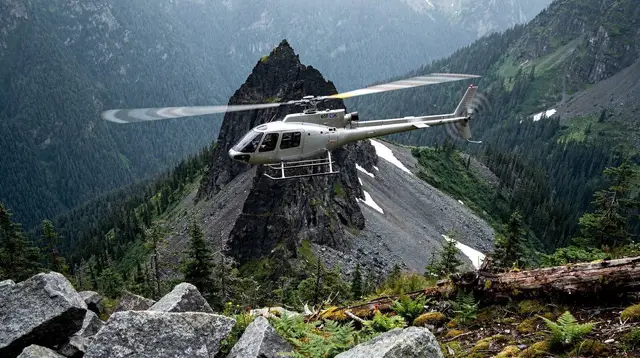
The centrepiece of most routes is the Black Tusk, the dark, jagged volcanic plug that rises to roughly 2,319 m above Garibaldi Provincial Park. From the ground it dominates the skyline for hikers heading toward Garibaldi Lake or Panorama Ridge; from a helicopter it becomes something closer to a single held frame — the whole formation visible at once, banded rock and old lava flow, without the two-day round trip a serious hiker would otherwise need.
Whistler Blackcomb carries three glaciers, and most scenic circuits are built to pass close by at least one or two of them, sometimes all three in a single loop. Seen from a car or a chairlift, a glacier reads as a distant white patch. From a couple of hundred metres up, the same ice shows crevasse fields, meltwater channels and the blue-white gradient that disappears from photos taken at ground level. Pilots typically narrate over the intercom — which glacier you’re passing, which peak is which — though the exact commentary depends on the operator and the day’s conditions.
Some routes also swing past the ridgelines and alpine bowls above Whistler Mountain and Blackcomb Mountain, giving a sense of scale for a resort that is, by skiable terrain, the largest in North America — a fact that is much harder to grasp from inside the village than from above it.
One honest caveat. Garibaldi Lake’s turquoise water is one of the most photographed views in this region, and it sits in the same general park as the Black Tusk — close enough that some visitors simply assume it’s part of the flight. It usually isn’t. Garibaldi Lake sits in a different valley from most Black Tusk and glacier loops, and unless an operator’s own route description names it specifically, do not book expecting to see it. Read the route, not the marketing photo.
Where the glacier landing tour differs — and why it isn’t covered here
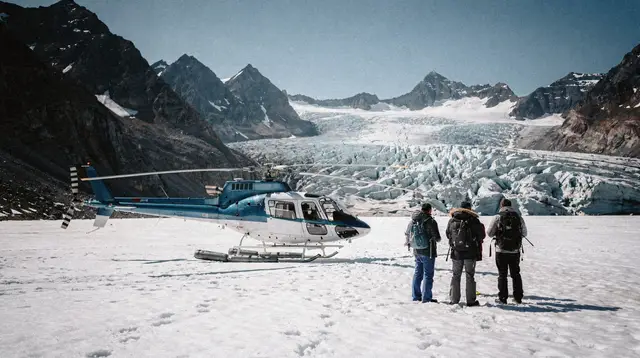
A glacier landing tour takes the same general flight path and adds a stop: the helicopter sets down on a snowfield, the doors open, and passengers step out onto the ice for several minutes before flying back. That single addition changes almost everything else about the product — flight time roughly doubles, the price rises accordingly, the aircraft needs suitable snow conditions to land safely, and the whole tour becomes more weather-sensitive at altitude than a flight that simply passes overhead and turns for home.
Because the two products solve different problems, this page deliberately stops at the comparison. If a landing on the ice is what you actually want, look for the dedicated glacier landing guide rather than trying to read that experience off this one — the details that matter (landing site selection, time on the snow, footwear, the stricter weather cutoffs) belong there, not here.
Scenic flight, glacier landing, or neither: a quick comparison
| No-landing scenic flight | Glacier landing tour | |
|---|---|---|
| Typical flight time | 15–30 minutes | Noticeably longer (see the landing guide) |
| Touches the ground mid-flight | No | Yes, on a snowfield |
| Relative price | Lower | Higher |
| Weather sensitivity | Standard for alpine flying | Stricter — landing needs suitable snow and calm air |
| Garibaldi Lake guaranteed | No — only if the operator’s route names it | No — same caveat applies |
| Best for | Tight schedules, first exposure to the terrain from the air | Visitors who specifically want time standing on the ice |
For a full comparison table of options and prices at the moment you book, the routes below are the current no-landing scenic circuits sold out of Whistler.
The two scenic-flight options, side by side
The most direct match for a pure scenic loop over the Black Tusk and Whistler Blackcomb’s glaciers is the Whistler helicopter tour over the glaciers and the Black Tusk, built specifically around that pairing rather than a broader resort flyover. If you’d rather fly a wider loop that takes in more of the peaks around the village before circling back, the Whistler summit scenic helicopter flight covers more of the alpine terrain above Whistler Village in a similar time window.
Neither of these lands. Both keep you strapped in for the entire booking, and both return to the same helipad you left from.
Not ready for the air? A ground alternative over the same corridor
If a helicopter isn’t the right fit — budget, comfort with small aircraft, or simply wanting a full day rather than half an hour — the same general geography is reachable by road. A Sea to Sky day tour with scenic stops along the highway covers waterfalls and viewpoints on the drive up from Vancouver, and won’t put you level with the Black Tusk’s summit, but it comes with none of the weather cancellations that ground alpine flights.
Price, and what actually drives it
Scenic helicopter flights are priced mostly by minutes in the air and by how many passengers share the aircraft — a private charter costs more per person than a shared seat on a scheduled departure. As a rough guide, a 15 to 20 minute shared loop sits at the lower end of what’s on offer; a longer route covering more of the three glaciers costs more, and a private booking for a small group costs more again. Glacier landing tours, doing more with the same aircraft, sit above all of these — check current tour pages for the figure on the day, since helicopter tour pricing moves with fuel costs and season more than most ground-based excursions.
Season and weather: what actually cancels a flight
These flights run year-round, but conditions differ sharply by season. In winter, the Black Tusk and the glaciers are fully snow-covered and dramatic, but low cloud ceilings are more common and cancel or shorten more departures. In summer, visibility is typically better and the exposed rock of the Black Tusk stands out clearly against the ice, though afternoon convective cloud can still build over the peaks by early afternoon — a reason many operators prefer morning departures.
Because the Black Tusk and Whistler Blackcomb’s summits sit well above the village, a clear day at Whistler Village is not a guarantee of a clear day at altitude. Rescheduling or a refund for a weather cancellation is standard practice with reputable operators, not a sign that something has gone wrong — build a spare day into your itinerary if the flight is a priority rather than a bonus.
Who should book the no-landing flight instead of the glacier landing
The scenic flight suits a shorter visit, a tighter budget, or a first look at this landscape from the air before committing to anything longer. It also suits anyone travelling with young children or a member of the group who wouldn’t be comfortable stepping out onto snow at altitude — the no-landing flight removes that entirely.
The glacier landing tour suits visitors who have already seen the mountains from the ground — from the PEAK 2 PEAK Gondola, say, or a hike near Squamish — and specifically want the different experience of standing on the ice itself, with the extra time and cost that involves.
Either way, book with a clear route description in hand. Ask, or check the tour listing, for exactly which glaciers and peaks the flight passes, and whether Garibaldi Lake is named at all — if it isn’t on the route, it isn’t on the flight, regardless of how the tour is photographed.
Planning the rest of the day around it
A scenic flight rarely fills more than an hour of a visit, door to door, which makes it easy to combine with almost anything else. Pair it with time in Whistler Village, a ride on the PEAK 2 PEAK Gondola for a ground-level look at the same terrain, or — for visitors with more time and fitness — the approach hike toward the Black Tusk itself, which is a serious scramble near the summit, not a casual walk. Anyone drawn to the lake views from the air should read up on the Garibaldi Lake hike directly, since that is the more reliable way to actually stand beside it.
For visitors coming up for the day rather than staying over, a scenic flight also slots cleanly into a longer day trip out of Vancouver — most people flying in through Vancouver International Airport will already be budgeting time for the Sea to Sky Highway drive, and a short helicopter loop fits at either end of that without derailing the rest of the plan. If a day trip is still being planned around the flight, a broader Sea to Sky and Whistler day tour from Vancouver covers the road portion so the helicopter booking can stay focused on the air alone.
For anyone weighing a scenic flight against Whistler Blackcomb’s terrain more generally, the guide to the size of the ski area and its glaciers is worth reading first — it puts the three glaciers seen from the air into the context of the resort as a whole, and makes clear why a fifteen-minute flight only ever shows a slice of it.
Booking practicalities: weight, seating and what to bring
These are small aircraft, and total payload matters more than it does on a bus or a boat. Most operators ask for an approximate weight for each passenger at the time of booking, and reserve the right to reseat the group, split it across more than one departure, or adjust the flight if the combined weight and balance doesn’t work for that airframe on the day. If your group includes a mix of adults and children, mention it when booking rather than at check-in — reshuffling seats on the helipad with other passengers waiting is avoidable friction.
Dress for a working helipad, not a lounge. Closed-toe shoes are the norm; loose scarves, wide-brimmed hats or anything that can lift in rotor wash should stay in the car or get tucked away before boarding. Sunglasses help against glare off the glaciers, particularly in winter and on bright summer mornings.
Cameras and phones are fine in the cabin, but the windows are sealed for the whole flight — there’s no opening them for a cleaner shot, so expect some reflection and plan your framing around it rather than pressing the lens flat to the glass. Headsets carry the pilot’s narration and let passengers talk to each other over the rotor noise, but that audio typically isn’t recorded for you to keep; photographs are the only souvenir most operators provide.
Ears, motion sickness and travelling with children
Flights this short are usually well tolerated even by people who get carsick on winding roads, since the ride is brief and largely stable in calm air. Expect more movement near ridgelines and in the afternoon, when rising warm air over the peaks can add light turbulence — another reason operators lean toward morning departures. The main physical sensation most first-timers notice is ear pressure on a rapid climb; swallowing or pinching the nose and blowing gently, the same trick used on a fixed-wing flight, clears it faster than waiting it out.
Helicopters don’t carry child car seats, so a young child flies in a regular seat with an adult-sized harness, and several operators set a minimum age or weight before they’ll book a child in at all — worth confirming directly rather than assuming a family of four can book as a single unit. In peak summer weeks, morning slots on the shorter scenic loop are the first to sell out; a flexible weekday morning generally has better last-minute availability than a Saturday afternoon in July or August.
Helicopter & Seaplane Tours on GetYourGuide
Verified deep-linked GetYourGuide tours. Book through these links and we earn a small commission at no cost to you.
GetYourGuide does not provide a product photo for this activity — the image shows the meeting point, photographed by us.