Whistler Blackcomb: The Biggest Ski Resort in North America
Why is Whistler Blackcomb called the largest ski resort in North America?
Whistler Blackcomb combines more than 8,000 acres (over 3,000 hectares) of skiable terrain across two mountains, over 200 marked runs, and three glaciers, which together make it the largest single ski area on the continent by skiable terrain. That figure is separate from Blackcomb's roughly 1,500 m vertical drop, which measures descent on one run, not the size of the terrain or the height of the peak.
The Numbers Behind the Claim
Ski magazines and travel writers have called Whistler Blackcomb the largest ski resort in North America for so long that the phrase gets repeated without anyone unpacking what it means. It is a real claim, backed by a real number, and it is worth being precise about which number that is, because Whistler Blackcomb throws several large figures at visitors at once: terrain size, run count, glacier count, and a vertical drop that gets confused with summit elevation more often than any other statistic on the mountain.
Here is the short version. Whistler Blackcomb spans more than 8,000 acres, or over 3,000 hectares, of skiable terrain across two mountains, joined at the base by Whistler Village and connected mid-mountain by the PEAK 2 PEAK Gondola. That combined acreage, not any single run or lift, is what makes it the largest ski area in North America. Everything else in this guide exists to explain how that terrain is put together, and to separate it clearly from a second, unrelated number: Blackcomb’s roughly 1,500 m vertical drop.
How Skiable Terrain Is Actually Measured
“Skiable terrain” sounds like it should be simple to measure, and in practice it is closer to a working estimate than a precise survey. Resorts calculate it as the area within their lift-served and patrolled boundary that can reasonably be skied, including groomed runs, ungroomed glades between runs, and open alpine bowls above the treeline. It does not include backcountry terrain reached by hiking or traversing beyond the boundary, even where that terrain is popular and well known.
On Whistler Mountain and Blackcomb Mountain combined, that comes to more than 8,000 acres, or over 3,000 hectares. Whistler Mountain contributes a mix of long groomed runs off its mid-station lifts and several big alpine bowls near its 2,182 m summit. Blackcomb contributes its own bowls, glades, and the glacial terrain near its higher, 2,284 m summit. Because the two mountains are treated as one operating area under a single lift ticket, their acreage is added together rather than compared separately, which is the basis for the “largest in North America” claim: no other single resort combines two mountains of this scale into one lift-served terrain figure.
It is worth being honest about the limits of that number too. A skiable-acreage figure counts terrain that is nominally accessible, not terrain that is open on any given day. Avalanche control, weather, and time of season all affect how much of that 8,000-plus acres a skier can actually reach on a specific visit, and none of that changes the headline total.
More Than 200 Marked Runs, and What Sits Between Them
The second figure attached to Whistler Blackcomb is its run count: more than 200 marked runs across both mountains. Marked runs are the named, graded trails shown on the resort’s trail map, colour-coded green, blue, black or double-black in the usual North American system. They range from long, wide cruisers accessed from the mid-mountain lifts to steep, narrow chutes and glades near the alpine.
That number is a useful shorthand, but it undersells how much of the mountain is actually skied. A large share of Whistler Blackcomb’s terrain sits between the marked runs, in the glades and open bowls that do not appear as named trails on the map at all. Locals and experienced visitors spend as much time in that unmarked terrain as on the runs themselves, particularly on a powder day. So while “200+ runs” is accurate and worth quoting, it describes only the labelled part of a much larger, more continuous skiable area, and it is a separate figure from the acreage total above, not a way of deriving it.
Run counts also shift slightly from season to season as the resort adjusts naming, merges or splits trails, or opens new terrain, so treat any specific number as a snapshot rather than a fixed fact. For visitors deciding which side of the resort to ski, a side-by-side look at where those runs sit is more useful than the raw count; see the comparison further down this page, and the fuller Whistler Mountain versus Blackcomb Mountain guide for a run-by-run breakdown.
Three Glaciers on One Lift Ticket
Whistler Blackcomb’s third headline number is that it has three glaciers inside its lift-served boundary: the Horstman, Blackcomb, and Decker glaciers, all on the Blackcomb side of the resort. Having lift access to glacial terrain is unusual for a resort at this latitude, and it is one of the reasons the mountain has historically supported skiing later into the season on its upper slopes than the lower mountain allows, and why summer glacier-based training camps have run here in some years.
Skiing on a glacier is not the same experience as skiing a groomed run lower down. Glacial terrain can have hidden crevasses, so it is patrolled and, where necessary, roped and marked to keep skiers on safe lines; wandering off marked glacier terrain is a real hazard, not a formality. The presence of three glaciers is also part of what supports Whistler Blackcomb’s claim to reliable natural snow and a long vertical of continuously skiable terrain, since glacier ice holds snow cover differently than exposed rock and alpine meadow lower on the mountain.
For a wider view of this high alpine terrain from the air rather than on skis, a helicopter flight over the glaciers and out toward the Black Tusk is one of the few ways to see all three glaciers and the surrounding Garibaldi Provincial Park terrain, including the volcanic plug of Black Tusk, in a single trip:
a helicopter flight over Whistler’s glaciers and the Black TuskBlackcomb’s 1,500 m Vertical Drop Is Not a Summit Height
This is the number that causes the most confusion, so it is worth stating plainly and then explaining why. Blackcomb Mountain has a vertical drop of approximately 1,500 m, measured from the top of its lift-served terrain down to the base at the valley floor. That is one of the largest continuous, lift-served vertical drops on the continent, and it is a genuinely different statistic from the mountain’s summit elevation.
Blackcomb’s summit sits at roughly 2,284 m above sea level. Whistler Mountain’s summit sits at roughly 2,182 m above sea level. Neither of those numbers is the vertical drop. Vertical drop measures the difference in elevation between the highest and lowest points of continuously skiable terrain on a single run or lift line; summit elevation measures the mountain’s height above sea level, which also includes the elevation of the valley floor it is measured from. Whistler Village itself sits at roughly 675 m, so Blackcomb’s vertical drop of about 1,500 m is consistent with a summit near 2,284 m and a base near 675 m, once you account for the fact that skiers do not descend the full straight-line difference on any single continuous run.
The practical reason this matters: articles and marketing material sometimes swap the two figures, describing “1,500 m peaks” or implying the mountain is 1,500 m tall above sea level, which is wrong on both counts. If you remember one rule from this page, make it this one: vertical drop describes how far down you ski; summit elevation describes how high up the mountain sits. They are related but not interchangeable, and Whistler Blackcomb’s size claim rests on terrain acreage and run count, not on vertical drop alone.
Whistler Mountain vs Blackcomb Mountain, Side by Side
| Measure | Whistler Mountain | Blackcomb Mountain |
|---|---|---|
| Summit elevation | ~2,182 m | ~2,284 m |
| Approx. vertical drop | Large, but Blackcomb’s is the taller of the two | ~1,500 m |
| Glaciers | None within the ski area | Three (Horstman, Blackcomb, Decker) |
| Village base elevation | ~675 m (shared village) | ~675 m (shared village) |
| Connected by | PEAK 2 PEAK Gondola | PEAK 2 PEAK Gondola |
Both mountains share the same base village and the same lift ticket, so most visitors ski both in a single trip rather than choosing one over the other for the whole stay. For a deeper look at how the two sides differ in terrain character, sun exposure and typical crowd patterns, see Whistler Mountain vs Blackcomb Mountain for skiing.
Two Mountains, One System: The PEAK 2 PEAK Gondola
Whistler Blackcomb’s size claim depends on treating two physically separate mountains as a single ski area, and the link that makes that possible is the PEAK 2 PEAK Gondola, opened in December 2008. It runs about 4.4 km between its two mid-mountain stations, with an unsupported span of roughly 3 km between towers and a maximum height above the valley floor of about 436 m, crossed in around 11 minutes.
Without the PEAK 2 PEAK, skiers would need to ride down to the shared village and back up the other mountain to move between Whistler and Blackcomb’s terrain, which is how the two areas operated for decades before the gondola opened. With it, both mountains function as one continuous ski circuit for the day, which is part of why their acreage, run counts and glacier terrain are quoted together as a single resort total rather than as two separate, smaller resorts.
Full technical detail on the gondola’s length, height and ride time is in a dedicated guide, PEAK 2 PEAK Gondola length, height and ride time; for how it stacks up against the valley’s other cable car, see PEAK 2 PEAK versus Sea to Sky Gondola.
How Whistler Blackcomb Compares to Other North American Resorts
Several other resorts in the United States and Canada claim superlatives of their own: the longest vertical drop on a single lift, the most annual snowfall, or the most acreage under one specific base area. What sets Whistler Blackcomb apart is the combination rather than any one figure in isolation: more than 8,000 acres of terrain, spread across two connected mountains, served by over 200 marked runs, reaching three glaciers, all on one lift ticket. No other North American resort combines terrain size, run count and glacier access at this scale within a single, interconnected system.
| Feature | Whistler Blackcomb |
|---|---|
| Skiable terrain | 8,000+ acres / 3,000+ hectares |
| Marked runs | 200+ |
| Glaciers within the ski area | 3 |
| Number of mountains | 2, connected by gondola |
| Blackcomb’s approximate vertical drop | ~1,500 m |
This table intentionally leaves out season dates and lift ticket prices, since both change from year to year; for current opening and closing timing see when do Whistler Blackcomb lifts open and close, and for how much a lift ticket actually costs, see Epic Pass and lift ticket prices at Whistler Blackcomb.
Where the Terrain Sits: Alpine Bowls and Glacial Skiing
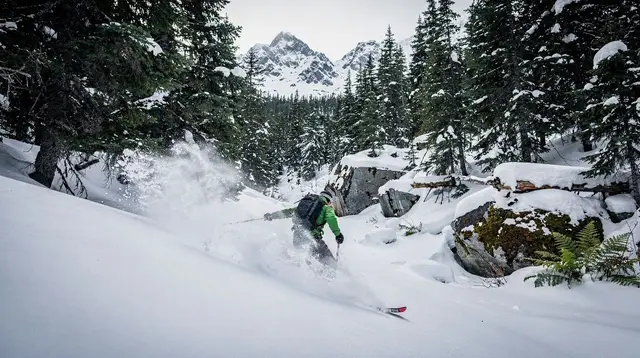
A large share of Whistler Blackcomb’s size comes from terrain most first-time visitors do not picture when they think “ski run.” Above the treeline on both mountains, the resort opens onto broad alpine bowls, wide, mostly treeless faces where the marked-run structure gives way to open terrain bounded by ropes and ski patrol markers rather than by trees. These bowls are a major part of the acreage total, and they are also where advanced and expert skiers spend most of a powder day, since the terrain is wider and less tracked out than the runs lower down.
Blackcomb’s glacial terrain sits above its own bowls, near the Horstman, Blackcomb and Decker glaciers. This upper terrain is what has historically allowed skiing to continue on the highest part of the mountain later into the season than conditions lower down would otherwise allow, and it is part of why Blackcomb’s overall vertical, from that high glacial start down to the village base, runs to roughly 1,500 m.
For skiers who want to go beyond the resort’s lift-served boundary into the surrounding backcountry, terrain around Garibaldi Provincial Park and the wider Sea to Sky corridor offers ungroomed, unpatrolled skiing and splitboarding well beyond Whistler Blackcomb’s own acreage figures, but that terrain is not avalanche-controlled and requires proper equipment, training and often a guide. An introductory guided outing is the standard way to try it safely for the first time:
an introduction to backcountry skiing and splitboarding around WhistlerSeeing the scale of the terrain from above, rather than from inside it, is the fastest way to understand why the acreage figure is so large. A helicopter tour over both mountains shows the connected bowls, the glaciers and the PEAK 2 PEAK span in a single flight:
a helicopter tour over Whistler and Blackcomb mountainsReading the Numbers Together
It is worth restating the four figures side by side one last time, because they answer four different questions, not one. More than 8,000 acres, or over 3,000 hectares, answers “how much terrain is there.” More than 200 marked runs answers “how is that terrain organised into named trails.” Three glaciers answers “how high and how permanent is the snow near the top.” And Blackcomb’s roughly 1,500 m vertical drop answers “how far down does a single run take you,” a figure that sits alongside, not on top of, Blackcomb’s approximately 2,284 m summit elevation and Whistler Mountain’s approximately 2,182 m summit elevation.
Put together, those four numbers are why Whistler Blackcomb is described as the largest ski resort in North America, and keeping them separate is the difference between repeating the claim accurately and mixing up a mountain’s height with how far a skier actually descends on it.
Whistler Blackcomb Terrain and Size FAQ
How many acres of skiable terrain does Whistler Blackcomb have?
Whistler Blackcomb spreads across more than 8,000 acres, or over 3,000 hectares, of skiable terrain on Whistler Mountain and Blackcomb Mountain combined. That total includes groomed runs, glades, alpine bowls and glacier skiing, and it is the figure most often cited to back the claim that this is the largest ski resort in North America.
How many marked runs are there at Whistler Blackcomb?
There are more than 200 marked runs spread across both mountains, ranging from long green cruisers off the mid-mountain lifts to black-diamond glades and alpine bowls near the summits. The count is a snapshot rather than a fixed number, since a handful of runs open and close from one season to the next.
Which glaciers can you ski at Whistler Blackcomb?
Whistler Blackcomb has three glaciers within its lift-served terrain, all on the Blackcomb side: the Horstman, Blackcomb and Decker glaciers. They sit near the top of the mountain and are part of what makes late-season and summer glacier skiing possible in some years.
What is Blackcomb’s vertical drop?
Blackcomb Mountain has a vertical drop of about 1,500 m from its upper lifts down to the valley base, one of the largest continuous vertical drops served by lifts in North America. It is measured top to bottom on a single descent, not as a total across the whole ski area.
Is Blackcomb’s 1,500 m vertical drop the same as its summit elevation?
No, and this is the most common mix-up on the mountain. Blackcomb’s summit sits at about 2,284 m above sea level, while its roughly 1,500 m vertical drop is the difference in height between the top of the skiable terrain and the valley floor, not the elevation of the peak itself.
How tall is Whistler Mountain compared to Blackcomb Mountain?
Whistler Mountain’s summit is about 2,182 m above sea level, while Blackcomb Mountain’s summit is about 2,284 m, making Blackcomb roughly 100 m higher. Both figures describe altitude above sea level, which is a different measurement from either mountain’s vertical drop.
Is Whistler Blackcomb really the largest ski resort in North America?
By skiable terrain, yes: its combined acreage across two mountains is larger than any other single ski area on the continent. Other resorts may claim more lifts, more vertical drop on a single run, or a longer season, but the terrain-size comparison is what the largest-in-North-America claim is based on.
Do Whistler Mountain and Blackcomb Mountain count as one resort or two?
They operate as one resort, Whistler Blackcomb, under a single lift ticket and a single operator, Vail Resorts. The two mountains are physically separate, divided by the Fitzsimmons Creek valley, and are connected by the PEAK 2 PEAK Gondola rather than by ski runs.
Skiing & Snowboarding on GetYourGuide
Verified deep-linked GetYourGuide tours. Book through these links and we earn a small commission at no cost to you.
GetYourGuide does not provide a product photo for this activity — the image shows the meeting point, photographed by us.