PEAK 2 PEAK Gondola: Length, Height and Ride Time Explained
How long does the PEAK 2 PEAK Gondola take, and how high above the valley does it go?
The PEAK 2 PEAK Gondola crosses from Whistler Mountain to Blackcomb Mountain in about 11 minutes, covering roughly 4.4 km of cable end to end. Its unsupported span between the two towers is about 3 km, and cabins reach up to about 436 m above the valley floor at the midpoint of that span.
The two numbers people mix up
Ask three people how big the PEAK 2 PEAK Gondola is and you will likely get three different answers, because the ride actually has two headline numbers and they measure different things. The total length of the line is about 4.4 km, station to station, from the Whistler Mountain side to the Blackcomb Mountain side.
The unsupported span between the two towers is about 3 km, and it is that middle section — the stretch with no tower holding the cable up from below — that made the PEAK 2 PEAK Gondola a record-setting piece of engineering when it opened. The two figures are related but not interchangeable: 3 km is part of the 4.4 km, not an amount added on top of it. If a number you read elsewhere doesn’t match either of those, it is worth checking which measurement it is actually describing.
This page sticks to the mechanics of the ride itself: how long it takes, how high it goes, how the line is built, and what those figures mean for planning a visit. It does not cover how the PEAK 2 PEAK compares with the Sea to Sky Gondola in Squamish — a different structure in a different location — or the alpine hiking trails it opens up in summer; both of those get their own dedicated coverage.
Ride time: about 11 minutes, one way
A single crossing of the PEAK 2 PEAK Gondola takes about 11 minutes, and that figure holds in both directions — Whistler to Blackcomb or Blackcomb to Whistler. Eleven minutes is the time spent in the cabin moving across the valley; it does not include getting to the Whistler-side or Blackcomb-side terminals in the first place, which for most visitors means riding another lift up from Whistler Village first.
Because the gondola runs continuously with cabins arriving every minute or so during operating hours, the practical wait for a car is usually short outside of peak midday periods. The bigger time cost on a typical day is less the 11-minute ride itself and more the sequence around it: getting up one mountain, crossing, then deciding whether to explore the second mountain or head straight back. Anyone building a single day around the gondola should budget well beyond the 11 minutes for the full loop, especially if lift lines or a mid-mountain lunch stop get added in.
Some visitors ride across and immediately ride back, treating it purely as a scenic there-and-back; others use it as a genuine link, skiing or exploring one mountain in the morning and the other in the afternoon. Either approach works, and neither takes much longer in gondola time than the other — the 11-minute crossing is the same whichever way the day is structured.
Total length: about 4.4 km end to end
The full line measures roughly 4.4 km from its Whistler Mountain station to its Blackcomb Mountain station. That distance includes the sections near each tower where the cable is still relatively close to the terrain, as well as the long open crossing in the middle. It is the number to use if someone asks “how long is the gondola line,” full stop — not the number to use if they are specifically asking about the unsupported stretch over open air, which is the smaller 3 km figure covered below.
For scale, 4.4 km is a distance most people could walk in under an hour on flat ground — except this “walk” happens above a forested valley, connecting two separate ski areas that used to require a full run down to the base and back up the other side to link on skis. Before the gondola existed, moving between Whistler Mountain and Blackcomb Mountain meant descending to the valley floor and taking a different lift system up the other side, a process that could eat the better part of an hour on a busy day. The 4.4 km aerial link cut that down to the 11-minute ride time above.
The unsupported span: about 3 km with no towers underneath
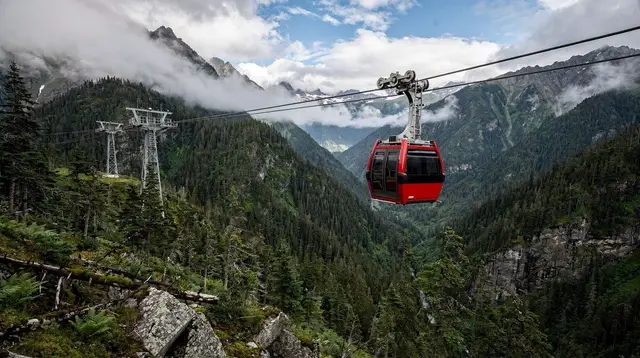
The number that gets the most attention, and the one most often confused with the total length, is the unsupported span of about 3 km between the two support towers that anchor the line on each side of the valley. For that entire middle stretch, nothing holds the cable up from below — no intermediate tower, no ground support, just the two end towers carrying the full tension across open air.
This is the section that made the PEAK 2 PEAK notable among aerial lift engineers when it opened: a 3 km unsupported span was, at the time, an unusually long distance for this kind of gondola system to cross without intermediate support. It is also the section responsible for most of the height figures people quote, since the lowest point of a long unsupported span sags furthest from its towers and passes highest above the valley floor beneath it.
The distinction matters practically, too. The 3 km unsupported stretch is where the ride feels most exposed — steady, smooth, but visibly suspended over a long drop with nothing directly below. The shorter approach sections nearer each tower feel comparatively ordinary, more like a typical mountain gondola. If height is a genuine concern, it is really that middle 3 km that deserves the mental preparation, not the ride as a whole.
Height above the valley: up to about 436 m
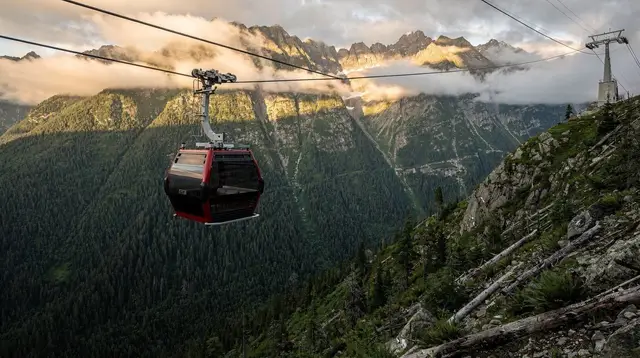
At its lowest point — where the unsupported span sags furthest between the two towers — a PEAK 2 PEAK cabin reaches up to about 436 m above the valley floor. That is roughly the height of a very tall skyscraper, held up by nothing but two cables anchored on separate mountains.
Height above the ground is not constant through the ride: cabins start close to their station platform, climb in relative height as the terrain below drops away toward the valley bottom, peak at around 436 m near the midpoint of the unsupported span, then descend again in relative height as they approach the far tower and station. Someone watching the ride purely as a number should know that 436 m describes a single point in the crossing, not the average height of the whole 11-minute trip.
A limited number of cabins have glass floor panels, giving an unobstructed view straight down through that maximum height point. They run on a normal rotation alongside standard cabins, so a rider cannot request one specifically, only hope for one to come around.
PEAK 2 PEAK Gondola: the numbers side by side
| Measurement | Figure | What it describes |
|---|---|---|
| Ride time | About 11 minutes | One-way crossing between the two mountain stations |
| Total line length | About 4.4 km | Whistler-side station to Blackcomb-side station, full distance |
| Unsupported span | About 3 km | The stretch between the two towers with no ground support |
| Maximum height above valley | About 436 m | Height at the lowest point of the unsupported span |
| Opened | December 2008 | First season of operation linking the two mountains |
Why the gondola was built this way
Whistler Mountain and Blackcomb Mountain are two separate ski areas divided by a valley, and for the resort’s first three decades the only way between them was down to the base and back up the other side. The PEAK 2 PEAK Gondola, which opened in December 2008, solved that by connecting the two mid-mountain areas directly across the gap, using the long unsupported span rather than a chain of intermediate towers that would have needed to be built up the valley slopes themselves.
That engineering choice is also what makes the gondola a summer attraction and not just a winter lift. Because it links two points high on each mountain rather than climbing from a base station, it stays useful — and scenic — once the snow is gone, carrying hikers and sightseers rather than skiers. The Whistler Blackcomb resort operates it on its own schedule across both seasons, separate from the regular lift network, which is one more reason to check current operating hours before planning around it rather than assuming it mirrors the ski lifts.
Planning a PEAK 2 PEAK ride around the numbers
Knowing the real figures changes how a day should be planned, not just what gets said about the ride afterward.
- If height is the concern, plan for the middle 3 km, not the whole ride. The approach sections near each tower are much less exposed than the unsupported span; expecting the whole 11 minutes to feel that way sets up unnecessary anxiety.
- If time is tight, 11 minutes is only the crossing. Add realistic time for reaching each mountain’s gondola station and for anything planned on the far side before committing to a tight schedule.
- If summer riding is the goal, don’t assume year-round hours. The gondola runs in both seasons but on its own calendar, and it is worth confirming current dates before a visit is built around it.
- If a guided day trip from Vancouver is easier than self-driving, several operators combine the PEAK 2 PEAK crossing with transport and other stops, which removes the logistics of parking and lift-ticket sequencing entirely.
For travellers coming up from the coast for the day, a guided day trip that includes the PEAK 2 PEAK crossing bundles the transfer, the gondola ride and usually free time in the village into one booking, which is often simpler than coordinating parking, lift tickets and timing independently.
Others prefer to combine the gondola with a stop at the Sea to Sky Gondola on the way up — a day trip pairing both gondola rides covers the whole corridor in a single outing, or a private electric-vehicle tour for a smaller group wanting more flexible timing.
Evening visitors sometimes stack a PEAK 2 PEAK ride earlier in the day with a completely different kind of after-dark outing, such as the night-time forest walk at Vallea Lumina, which sits close to the village and needs no mountain access at all.
Getting the most out of the ride
A few practical points make the crossing more enjoyable regardless of which direction it’s ridden. Weekday mornings and early afternoons tend to have shorter waits than weekend midday hours, when both mountains are busiest with skiers and sightseers moving between them.
Clear days obviously make the most of the height and views, but the enclosed cabins run in poor weather too, when low cloud can mean the famous 436 m drop simply isn’t visible — worth knowing if visibility is a priority rather than just the ride itself. Photographers should aim for a side seat near a window rather than the centre of a cabin, since the best views of the supporting towers and the open valley below come from the edges rather than looking straight down the line of travel.
Anyone combining the PEAK 2 PEAK with a broader look at the resort’s gondola rides category, or planning a first visit to Whistler Village more generally, will find the crossing fits naturally into a single well-paced day rather than needing its own dedicated outing — see a one-day village itinerary for how it typically slots in alongside other village-based activities.
PEAK 2 PEAK Gondola: frequently asked questions
How long is the PEAK 2 PEAK Gondola ride?
A one-way crossing takes about 11 minutes, whichever direction you travel. That figure covers only the cable ride between the Whistler Mountain and Blackcomb Mountain stations, not the time it takes to reach either base station or ride up to the mid-mountain terminals first.
How long is the PEAK 2 PEAK Gondola in total?
The full line runs about 4.4 km from the Whistler side station to the Blackcomb side station. That total includes the approach sections near each tower, not just the open crossing over the valley.
What is the unsupported span, and how is it different from the total length?
The unsupported span is the roughly 3 km stretch of cable between the two support towers where nothing holds the line up from below. It is a subset of the 4.4 km total length, not a separate or additional distance, and it is the section people mean when they call the PEAK 2 PEAK a record-setting gondola.
How high above the valley does the PEAK 2 PEAK Gondola go?
Cabins reach up to about 436 m above the valley floor at the lowest point of the unsupported span, roughly midway between the two mountains. Height above the ground changes throughout the ride as the terrain below rises and falls.
When did the PEAK 2 PEAK Gondola open?
It opened in December 2008, built to link the two separate ski areas of Whistler Mountain and Blackcomb Mountain without a return to the valley floor.
Can you ride the PEAK 2 PEAK Gondola in summer?
Yes. It operates in both winter and summer seasons, on its own separate operating schedule from the ski lifts, so always check current hours before basing a day around it.
Is the PEAK 2 PEAK Gondola scary if you don’t like heights?
The scale is real: up to 436 m of open air below a fully enclosed cabin, with no towers directly underneath for most of the crossing. Many nervous flyers find the smooth, level motion and glass floor cabins (available on a limited number of cars) more reassuring than a chairlift, but it is a legitimate concern to plan around rather than dismiss.
Do you need a lift ticket to ride the PEAK 2 PEAK Gondola?
In winter it typically requires the same lift access as skiing and riding. In summer it is usually sold as a standalone sightseeing ticket, often bundled with mountain access, so check what a given ticket or tour actually includes before buying.
Gondola Rides on GetYourGuide
Verified deep-linked GetYourGuide tours. Book through these links and we earn a small commission at no cost to you.
GetYourGuide does not provide a product photo for this activity — the image shows the meeting point, photographed by us.