Is Green Lake Good for Paddling and Swimming?
Can you swim and paddle in Green Lake in Whistler?
Yes. Green Lake is one of four Whistler lakes commonly cited as swimmable from around July to early September, alongside Alta, Lost and Alpha lakes. It sits at the downstream end of the River of Golden Dreams from Alta Lake, with Whistler Mountain and Blackcomb Mountain rising directly behind it.
Ask around Whistler Village which lake to swim in and most people say Alta Lake first, because it sits closest to the pedestrian core and has the best-known beaches. Fewer visitors think to ask about Green Lake, further up the valley — and yet it belongs on the same short list.
Whistler’s summer swimming season generally centers on four lakes: Alta, Lost Lake, Green and Alpha, all cited as swimmable from roughly July into early September. Green Lake earns its place on that list, and it brings something the others don’t: it is the point where the River of Golden Dreams finishes its short run from Alta Lake, and it sits directly beneath the valley’s two defining peaks.
This guide answers the practical question — can you actually swim and paddle here, and how does it compare — without wandering into the canoe route itself, which has its own dedicated write-up, or repeating everything about Alta Lake, which is covered elsewhere. What follows is Green Lake on its own terms.
Green Lake at a Glance
Green Lake lies at the northern end of the Whistler valley, downstream of Whistler Village and past Alta Lake along the valley’s chain of waterways. It is one of the four lakes locals and repeat visitors point to when the subject of a summer swim comes up, sitting alongside Alta, Lost and Alpha lakes in that July-to-early-September window when the valley’s water finally warms enough to be inviting rather than shocking.
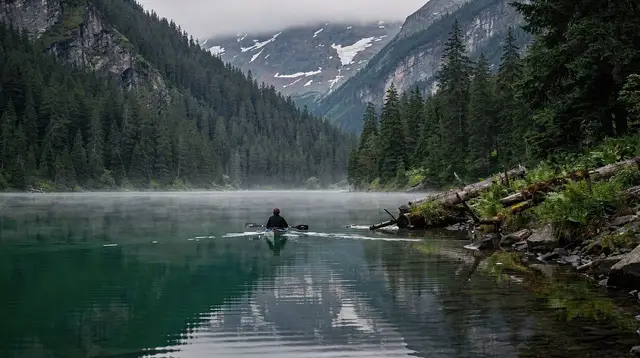
What sets Green Lake apart from the others isn’t a beach or a boathouse — this guide won’t invent specifics on facilities that aren’t confirmed here — it’s the setting. Whistler Mountain, rising to around 2,182 metres, and Blackcomb Mountain, a touch higher at about 2,284 metres, both dominate the skyline directly from the water’s surface. Few lakes in the resort put both summits in the same frame as clearly as Green Lake does, especially in the early morning before the wind picks up and the surface is still glassy.
Is Green Lake Actually Swimmable?
The short answer is yes, with the same caveat that applies to every lake in this valley: “swimmable” here means a mountain lake fed in part by glacial and snowmelt water, not a warm-water lake in the way a lowland lake further south might be. Green Lake is grouped with Alta, Lost and Alpha as one of the four lakes where people do swim through the summer, but nobody should expect bathtub temperatures. The water is refreshing at best and genuinely cold outside the core of summer.
That’s a feature as much as a limitation. On a hot July or August afternoon, after a morning on the Whistler Mountain Bike Park or a hike out of the village, a cool-down in Green Lake does exactly what it should. The trade-off is that the swimmable window is genuinely seasonal — this isn’t a lake to plan a swim around in May, June or October, when the water carries far more of its glacial chill.
Green Lake and the River of Golden Dreams
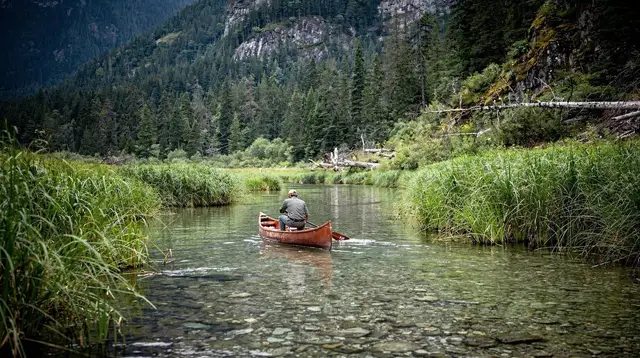
Green Lake’s other defining feature is where it sits in the valley’s water system. The River of Golden Dreams begins at Alta Lake and winds its way north through wetlands and forest before emptying into Green Lake — making Green Lake the destination, not the starting point, of one of Whistler’s best-known summer paddles. This guide isn’t the place for the details of that canoe or paddleboard route between the two lakes; a dedicated page on canoeing the River of Golden Dreams from Alta to Green covers the put-in points, the current and the timing.
What matters here is the implication for anyone thinking about Green Lake specifically: if a canoe trip down the river is on the itinerary, Green Lake is where it naturally ends, and a swim or a slower paddle around the lake itself is a logical way to close out that day rather than an entirely separate outing.
Paddling on Green Lake: What to Expect
Paddlers who put in directly on Green Lake — rather than arriving via the river from Alta Lake — are dealing with a different kind of water than the sheltered, narrower channels upstream. Green Lake is a broader, more open expanse, and open water in a mountain valley tends to catch more wind than a tucked-away bay. Afternoons in particular can turn choppier than a first-time paddler might expect, so it’s worth checking conditions before setting out and staying closer to shore if a breeze has picked up.
For anyone who wants a guided introduction to paddling around the Sea to Sky region rather than going it alone, a guided wilderness outing in the Whistler backcountry is a good way to get oriented with a local guide first, even though it isn’t a paddling tour itself — it’s a useful primer on the terrain and wildlife awareness that applies just as much around the lakes as on the trails. Those planning to paddle unguided should bring their own kayak, canoe or SUP, since this guide won’t claim a specific on-site rental operation at Green Lake that isn’t confirmed; visitors coming from Squamish can sort gear before heading north.
Green Lake Compared with Whistler’s Other Three Swimmable Lakes
None of these four lakes behave identically, and knowing the differences helps decide where to spend an afternoon.
| Lake | Role in the valley | What it’s known for |
|---|---|---|
| Alta Lake | Village-adjacent, source of the River of Golden Dreams | Closest lake to Whistler Village, most visited beaches |
| Lost Lake | Short walk from the village via the Valley Trail | Popular swimming spot, easy access, forested setting |
| Green Lake | Downstream end of the River of Golden Dreams | Open water, direct views of Whistler and Blackcomb mountains |
| Alpha Lake | South of the village core | Quieter, smaller, less trafficked than the others |
Green Lake’s position on this list is really about trade-offs. It is further from the village core than Lost Lake’s easy stroll, and it doesn’t carry Alta Lake’s reputation as the default swimming spot. What it offers instead is space, a sense of being further into the valley, and that direct sightline up to both major peaks — worth the extra distance for anyone who prioritizes the view over convenience.
Views of Whistler and Blackcomb from the Water
It’s worth dwelling on the mountain backdrop, because it’s genuinely one of Green Lake’s strongest arguments. From most points on the lake, both Whistler Mountain and Blackcomb Mountain are visible at once, their ridgelines framing the water in a way that’s harder to get from Alta Lake or Lost Lake, both of which sit closer under the shoulder of the mountains rather than looking across the valley at them. On a clear summer morning, before the wind builds and the water is still calm, this is one of the better low-effort photo opportunities in the resort — no hike required, just a short trip to the lakeshore.
For a different angle on the same peaks, an aerial view puts the whole valley into perspective in a way the shoreline can’t. A helicopter tour over Whistler and Blackcomb shows how Green Lake, Alta Lake and the River of Golden Dreams fit together as one connected system beneath the two mountains, which is a genuinely useful way to understand the valley’s geography before or after spending time at lake level.
Getting to Green Lake
Green Lake sits north of Whistler Village, reachable by car, bike or the valley’s local bus network along the route that runs past Alta Lake. It isn’t served by the same dense cluster of trails and access points as Lost Lake, so a plan is worth having before setting out, whether that means driving to a pull-off, cycling the valley’s paved paths, or combining the visit with a paddle down from Alta Lake via the River of Golden Dreams. Because Whistler Village itself is pedestrian, most visitors base themselves there and make the short trip out to Green Lake as a half-day or full-day addition rather than a walk-out-the-door outing.
Those road-tripping the wider Sea to Sky corridor and stopping in Whistler as part of a longer loop often pair a Green Lake afternoon with stops further south. A combined outing that also takes in the Sea to Sky Gondola, Shannon Falls and a look at Green Lake from the road is a practical way to see several of the valley’s landmarks in one day. A Sea to Sky Gondola, Shannon Falls and Green Lake tour covers exactly that combination for anyone who would rather not self-drive the whole corridor.
When to Go: Best Months for Swimming and Paddling
The realistic window for swimming or a relaxed paddle on Green Lake tracks the same broad pattern as the rest of Whistler’s lakes: July through early September, once the snowmelt has eased off and the valley has had a stretch of warm days to bring the water temperature up. Outside that window — spring through June, and again from mid-September on — the lake is still there and still paddleable for those equipped for cold water, but it stops being a casual swim spot.
Late June can go either way depending on how the winter snowpack has behaved that year; a heavy snow year pushes the comfortable swimming window later into July. Anyone timing a trip specifically around lake swimming should build in some flexibility rather than locking a single date to a single lake.
Safety and Practical Notes
A few points worth keeping in mind rather than assuming: Green Lake, like every lake in this valley, is fed at least in part by mountain runoff, so cold-water shock is a real risk even on a hot day — ease in rather than jumping straight from a warm car into the water. Life jackets matter on any non-motorized craft, wind can build through the afternoon on open water, and there is no lifeguard presence to rely on at any of Whistler’s lakes. Black bears move through this part of the valley as they do throughout the Whistler area, most often between May and October, so standard food-storage and awareness practices apply at the lakeshore just as they do on the trails.
Green Lake does not sit inside a provincial park, so unlike Garibaldi Lake or Joffre Lakes there is no day-use pass system to navigate here — one less logistical hurdle for a same-day plan.
Making a Day of It Around Green Lake
Green Lake rarely needs to be the entire plan for a day. Its position at the north end of the valley puts it within easy reach of other things to do around Whistler without much backtracking. A morning on the water, followed by lunch back in the village and an afternoon doing something entirely different, is a natural rhythm. For visitors who’d rather stay dry after a swim, options nearby include a scenic flight, a mountain activity, or a cultural stop such as the Audain Art Museum or the Squamish Lil’wat Cultural Centre.
Those craving more adrenaline than a swim provides sometimes confuse Green Lake with the Green River, a separate waterway near Whistler known for whitewater rather than a calm summer swim. A whitewater rafting adventure on the Green River is the activity to book for rapids — Green Lake itself stays firmly in swim-and-paddle territory, calm rather than churning.
Frequently Asked Questions About Swimming and Paddling at Green Lake
Is Green Lake as warm as Alta Lake for swimming?
Both are glacially influenced mountain lakes and neither turns bath-warm, but Green Lake is grouped with Alta, Lost and Alpha as swimmable through the July-to-early-September window. Expect brisk water rather than a heated pool, and ease in gradually.
Is Green Lake good for stand-up paddleboarding?
Green Lake is paddled by SUP and kayak, but it is a larger, more open body of water than the sheltered bays typical of Alta Lake, so it catches more wind. Check conditions before heading out and stay closer to shore if it is breezy.
Where does the River of Golden Dreams end?
The River of Golden Dreams flows from Alta Lake to Green Lake, making Green Lake its downstream terminus. The paddle itself is covered on a dedicated guide rather than here.
Can you see Whistler Mountain and Blackcomb from Green Lake?
Yes. Green Lake sits in the same valley floor as Whistler Village, with Whistler Mountain (about 2,182 m) and Blackcomb Mountain (about 2,284 m) both visible from the water, making it one of the more photogenic lake views in the resort.
Is Green Lake busier or quieter than Alta Lake?
This guide does not cover Alta Lake’s specifics, but the two lakes have different characters: Alta sits closer to the village and its beaches, while Green Lake is a larger, more open stretch of water further from the pedestrian core.
When is the best time to swim or paddle Green Lake?
Roughly July through early September lines up with when Whistler’s lakes are generally cited as swimmable, once the alpine snowmelt has eased and daytime temperatures have climbed. Outside that window, the water is colder and less inviting.
Do you need a permit to paddle on Green Lake?
Green Lake is not inside a provincial park requiring a day-use pass, unlike Garibaldi Lake or Joffre Lakes. Bring your own non-motorized craft or book a guided tour, and follow standard boating and life-jacket rules.
For anyone still deciding when to build a trip around the valley’s lakes at all, a broader look at the best time to visit Whistler and how summer compares with winter helps put Green Lake’s short swimming season into the context of a full trip, alongside notes on swimming with kids at Lost Lake and renting kayaks in nearby Squamish for those extending the water time beyond Whistler itself. For the full activity list in this category, see kayaking and paddling around Whistler.
Kayaking & Paddling on GetYourGuide
Verified deep-linked GetYourGuide tours. Book through these links and we earn a small commission at no cost to you.
GetYourGuide does not provide a product photo for this activity — the image shows the meeting point, photographed by us.