Is There a Train to Whistler? The Honest Answer
Is there a train to Whistler?
No. Whistler has never had a passenger rail line and has no train station today. The only ways in are Highway 99 by car, scheduled coach, private transfer, or occasionally seaplane or helicopter.
No, Whistler Has No Train — Here Is How People Actually Get There
The short answer, before anything else: there is no train to Whistler. Not a regular passenger service, not a seasonal tourist line, not a heritage railway that runs a few times a year. Whistler has never had a train station, and it has no airport either. Every visitor who is not driving arrives by scheduled coach, private transfer, or — for a smaller number, at a much higher price — seaplane or helicopter. This page exists because the opposite idea circulates constantly online, usually confused with a real train that runs nowhere near Whistler. Below is the full picture, plainly stated, with no rail journey invented to fill the gap.
Why the Rail Question Keeps Coming Up
Three things feed the confusion. First, Vancouver itself has extensive rail transit — SkyTrain, the West Coast Express — and visitors reasonably assume the same infrastructure extends up the Sea to Sky Highway. It does not; none of Vancouver’s rail lines leave the metro area in that direction. Second, British Columbia does have a genuine, famous train: the Rocky Mountaineer, a multi-day tourist rail experience through the BC Interior and the Canadian Rockies, on routes between Vancouver, Whistler-adjacent Kamloops, Banff, and Jasper.
Its routes pass nowhere near Whistler itself, and no branch line, shuttle connection, or partnership links it to the resort. If you have seen the Rocky Mountaineer mentioned alongside Whistler in a blog post or forum thread, it is almost always a mix-up, not a real option. Third, Whistler hosted alpine events for the 2010 Vancouver Winter Olympics, and large-scale Olympic infrastructure investment naturally gets associated with rail upgrades in other host cities. In Whistler’s case, the Olympic investment went into widening and straightening Highway 99, not into laying track.
A Resort Built Around a Road, Not a Railway
Whistler’s layout explains a lot of this. Whistler Village itself was built from 1978 to 1980 on a former municipal landfill — a functional, purpose-built base for a ski resort, not a town that grew up around a station the way many European or even Eastern Canadian mountain towns did. The Resort Municipality of Whistler, created in 1975, was designed from the outset around highway access: Highway 99 connects Vancouver to Whistler and continues north to Pemberton and beyond.
No rail line was ever routed through the Cheakamus Canyon or across Howe Sound to reach it. That absence is not a gap waiting to be filled — it is simply how the corridor was built, and it has stayed that way through more than four decades of the resort’s growth, a 2010 Olympic Games, and Whistler Blackcomb’s current life as North America’s largest ski resort by skiable terrain.
How People Actually Get to Whistler
With rail off the table, four real options remain. This page covers what each one is; exact prices, schedules and step-by-step booking advice for the Vancouver–Whistler leg live on dedicated pages linked below, since those numbers change often enough that repeating them here would go stale.
By car
Driving is the most common way to reach Whistler. The Sea to Sky Highway runs the roughly 121 km from Vancouver, or about 135 km from Vancouver International Airport (YVR), and the drive itself is one of the scenic highlights of the trip, passing Porteau Cove, Squamish and the Tantalus lookout.
It is also a mountain highway that can close for rockfall, snow, or collisions, and winter tyres or chains are a legal requirement from 1 October to 30 April, not a suggestion. Anyone planning to drive should read the practicalities in full before setting out — see Driving Highway 99: What to Know and Highway 99’s Winter Tyre Rule Nobody Warns You About.
By scheduled coach
For visitors without a car, scheduled coach shuttles are the closest thing to public transport between Vancouver (or YVR) and Whistler, running multiple times a day year-round. This is the option most similar in spirit to a train — fixed departures, a set fare, no need to drive yourself — and it is genuinely the answer for most people asking whether they need a rental car at all. The full comparison of operators, journey times and how to book sits on its own page: How to Get from Vancouver to Whistler and, specifically for airport arrivals, Vancouver Airport to Whistler: Transfer Options.
By private transfer
Private vehicle transfers cost more than a shared coach but run on your own schedule, door to door, useful for late flights, large groups, or families with a lot of luggage. They use the same Highway 99 route as everything else on wheels — there is no faster road option, only a more private one.
By seaplane or helicopter
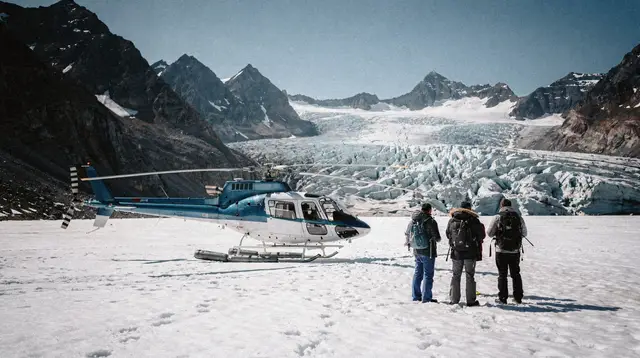
A small number of visitors skip the highway altogether. Seaplanes fly from Vancouver’s harbour direct to Green Lake in Whistler in good weather, and helicopters offer sightseeing flights and, less commonly, point-to-point transfers. Both are dramatically more expensive than road options and weather-dependent, so they suit a scenic splurge more than routine transport.
If a flight over the Coast Mountains appeals regardless of how you get to Whistler, a scenic tour is worth booking on its own terms: a Whistler and Blackcomb helicopter tour shows the glaciers, alpine bowls and the full length of the Sea to Sky corridor from above — genuinely one of the best ways to understand the scale of the terrain you have just read isn’t served by rail. For the fixed-wing version and how it differs from a transfer flight, see Seaplane Flight, Vancouver to Whistler and Whistler Seaplane: Scenic Tour vs. Transfer.
Comparing the Options at a Glance
| Method | Runs on rails? | Typical journey time (Vancouver to Whistler) | Best for |
|---|---|---|---|
| Driving Highway 99 | No | 1 h 45 min–2 h 30 min | Flexibility, side trips to Squamish and the Sea to Sky Gondola |
| Scheduled coach | No | Roughly 2–2.5 hours | Travellers without a car, budget-conscious trips |
| Private transfer | No | Roughly 2–2.5 hours | Groups, late arrivals, door-to-door convenience |
| Seaplane | No | About 30–40 minutes | A scenic splurge, good weather only |
| Helicopter | No | Under 30 minutes for transfer, longer for a scenic loop | Sightseeing first, transport second |
| Train | Does not exist | — | — |
The last row is there deliberately: no matter how the comparison is framed, rail is not and has never been part of the answer.
What This Means for Trip Planning
Because there is no train and no airport at Whistler, every itinerary needs to account for one land or air leg from Vancouver or YVR, both on the way in and the way out. That single fact shapes a few practical decisions. Anyone flying into YVR should build in the transfer time — closer to 2 hours 30 minutes than the more optimistic 1 hour 45 minutes quoted for a direct Vancouver-to-Whistler drive — when timing connecting flights or late check-ins.
Anyone considering a single-day visit should weigh whether the return road time makes sense against the hours actually spent in Whistler; see Is a Whistler Day Trip from Vancouver Worth It? for a direct answer. And anyone who dislikes mountain driving in winter has a real, well-used alternative in the scheduled coach network, not just a private-transfer workaround.
It is also worth saying plainly: none of this makes Whistler hard to reach. Millions of visitors — the resort welcomes on the order of 3 million a year — arrive without ever missing a train that does not exist. The corridor is simply built around Highway 99, and the transport options above cover every budget and comfort level that a rail service would otherwise have served.
Once You Arrive, You Won’t Need a Car
Here is the part that surprises people who assumed a train-free destination must also be car-dependent once they’re there: Whistler Village itself is pedestrian, cars are parked at its edges, and the WAVE local bus network covers the wider valley — Alta Vista, Nordic, Emerald and beyond — well enough that day-to-day movement rarely requires a vehicle. Many visitors who arrive by coach or private transfer never rent a car at all.
For evening plans within walking or shuttle distance of the village, a guided outing is an easy way to fill a car-free night — a Vallea Lumina night walk through the forest or, for something more active, a zipline experience above the valley both run with hotel or village pickup built in.
Longer excursions into the backcountry, similarly, are usually run as guided trips rather than self-drive outings — a guided wilderness hike or a side-by-side off-road adventure both handle the driving for you on terrain a standard rental car would not be suited to anyway.
Planning Further
Once the “no train, no airport” fact is settled, the practical next questions are usually about the Vancouver leg itself, how long to budget for the whole trip, and when to go. Those are each covered in depth elsewhere: How Many Days Do You Need in Whistler?, Vancouver to Whistler Day Trip Without a Car, and for winter travellers specifically, What to Pack for Whistler in Winter.
The transfers and getting there hub collects every transport-related guide on the site in one place, and the Vancouver activities hub is worth a look if a stopover in the city is part of the plan. For budgeting the trip overall, including transport costs alongside lift tickets and accommodation, the budget planning tool is a faster starting point than piecing numbers together from separate pages.
The Closest Passenger Rail Line, and Why It Doesn’t Help
Metro Vancouver’s West Coast Express commuter train is the nearest scheduled passenger railway to the Sea to Sky corridor, and it still doesn’t reach anywhere close. It runs east from Waterfront Station in downtown Vancouver to Mission — the opposite direction from Whistler — and its route stops well short of even Squamish, let alone the resort. There is no track, spur line, or connecting shuttle linking it to Highway 99. Anyone who searches for “the nearest train station to Whistler” and finds this service is looking at a station roughly 100 km from the resort, on the wrong side of the city, running on weekday commuter hours aimed at Vancouver office workers rather than travellers.
Two Gondolas, Often Mistaken for Rail
Two aerial cableways serve this corridor, and the confusion between them sometimes gets folded into the train question. The PEAK 2 PEAK Gondola connects Whistler and Blackcomb mountains at altitude, entirely within the resort, and is a lift pass or day-ticket product, not a way to reach Whistler from Vancouver. The Sea to Sky Gondola is a separate attraction with a different operator, based in Squamish — roughly 60 km south of Whistler and close to the midpoint of the Highway 99 drive.
Neither is rail and neither shortens the road journey, but travellers who plan a stop at the Sea to Sky Gondola on the way up should budget parking time at its base, since the lot at the highway turnoff fills on clear weekends well before midday, pushing later arrivals into a wait for the next available departure slot.
Frequently Asked Questions About the Train to Whistler
Is there a train from Vancouver to Whistler?
No. There is no passenger rail service between Vancouver and Whistler and there never has been. Every option — car, coach, private transfer, seaplane, helicopter — runs on Highway 99 or through the air, not on rails.
Does Whistler have a train station?
No. Whistler has no railway station of any kind, historic or current. Visitors arriving by public transport use the coach terminal in Whistler Village, not a station.
Why doesn’t Whistler have a train, despite hosting the Winter Olympics?
Whistler grew from the 1960s onward as a purpose-built ski resort reached by road, and the 2010 Winter Olympics upgraded Highway 99 rather than adding rail. No railway was ever routed through the Sea to Sky corridor to Whistler.
Is there an airport at Whistler?
No. Whistler has no commercial or scheduled airport. The nearest major airport is Vancouver International Airport (YVR), roughly 135 km away, connected to Whistler by road only.
What is the fastest way to get from Vancouver to Whistler without driving?
Scheduled coach shuttles from Vancouver and YVR are the fastest regular public option, running several times a day on Highway 99. Private transfers and, for a premium, seaplane or helicopter flights are faster still but cost considerably more.
Can I take the Rocky Mountaineer to Whistler?
No. The Rocky Mountaineer is a long-distance tourist train that operates in the BC Interior and the Rockies, on routes such as Vancouver to Banff or Jasper. It does not run to Whistler, and no branch or connecting service links it to the resort.
Are there seasonal or tourist trains to Whistler?
No. No seasonal, heritage, or tourist train has ever operated to Whistler. This is one of the most persistent myths about the resort, and it is worth checking before you plan a trip around a rail journey that does not exist.
Transfers on GetYourGuide
Verified deep-linked GetYourGuide tours. Book through these links and we earn a small commission at no cost to you.
GetYourGuide does not provide a product photo for this activity — the image shows the meeting point, photographed by us.